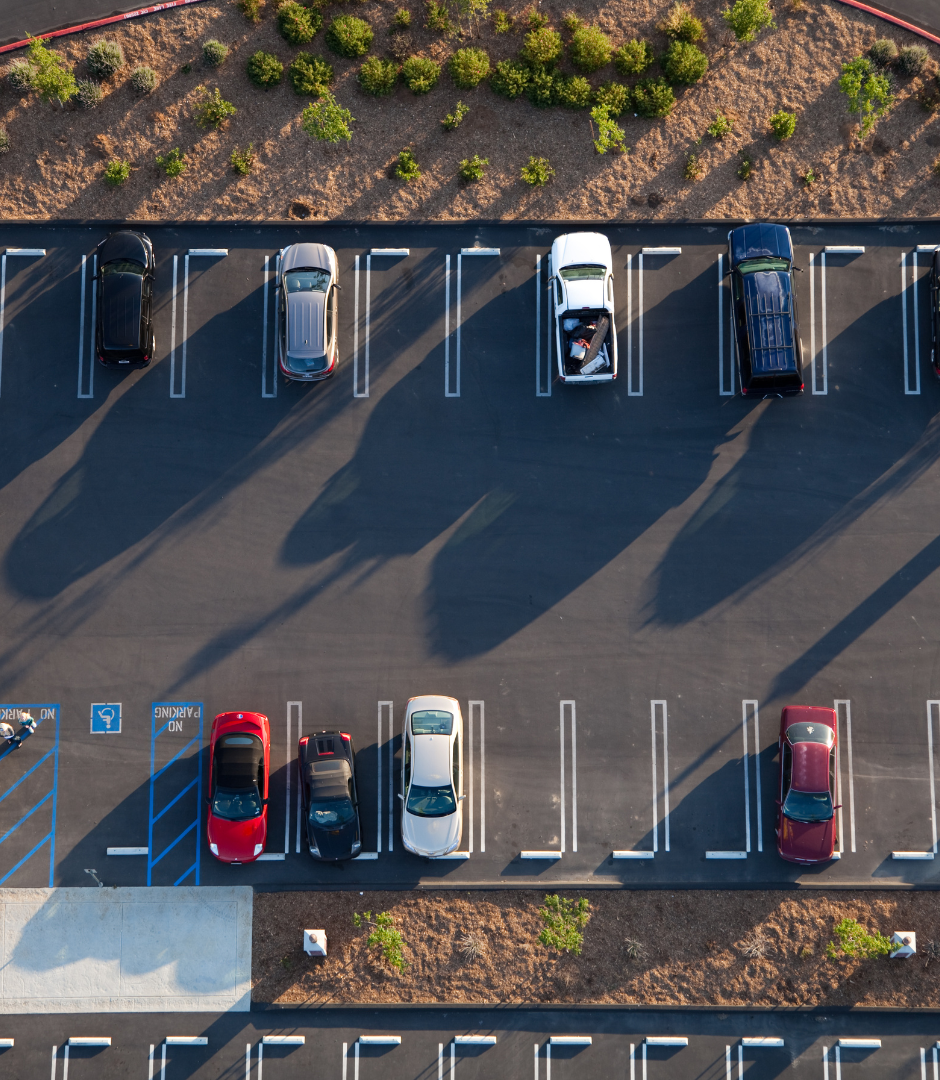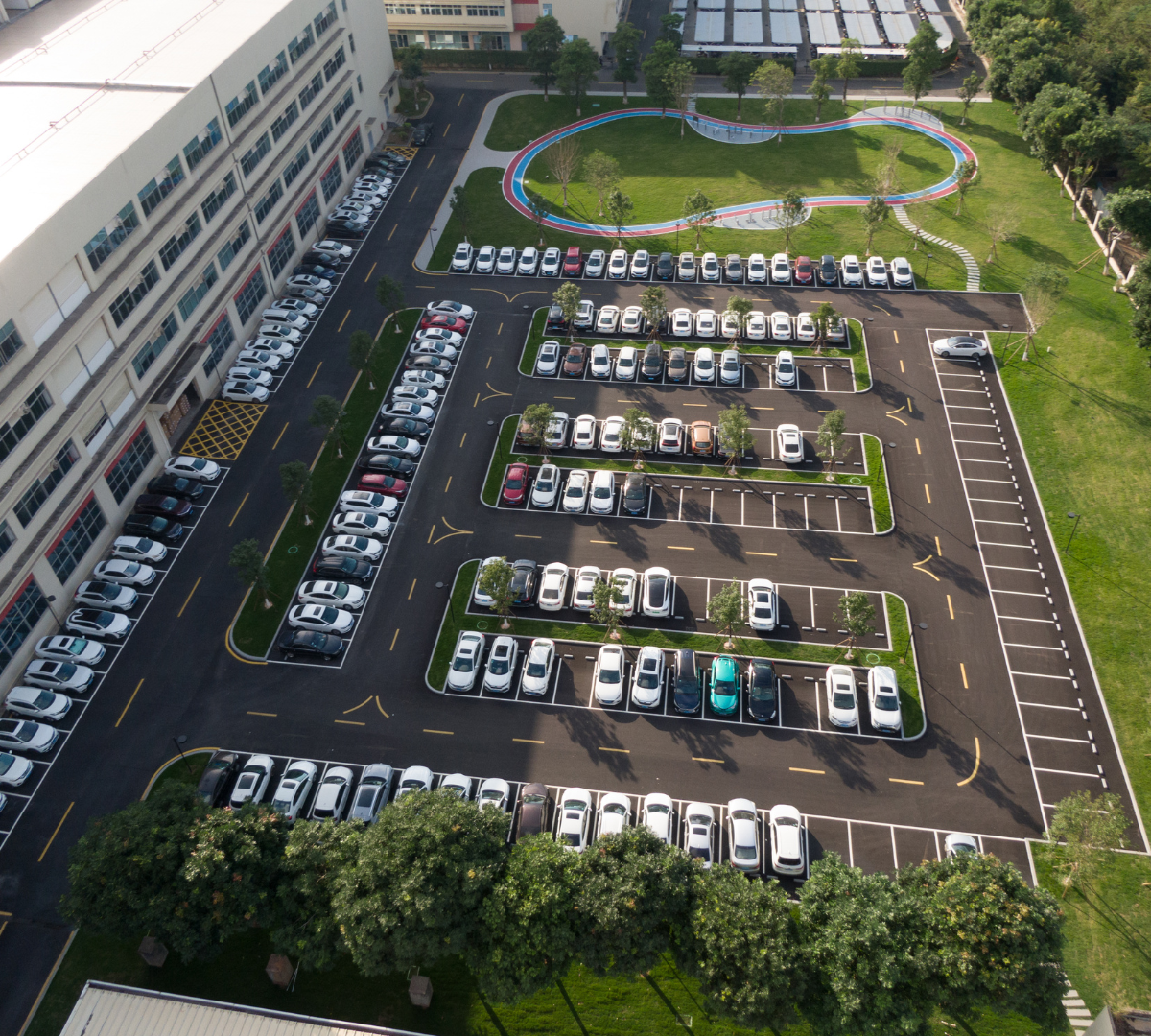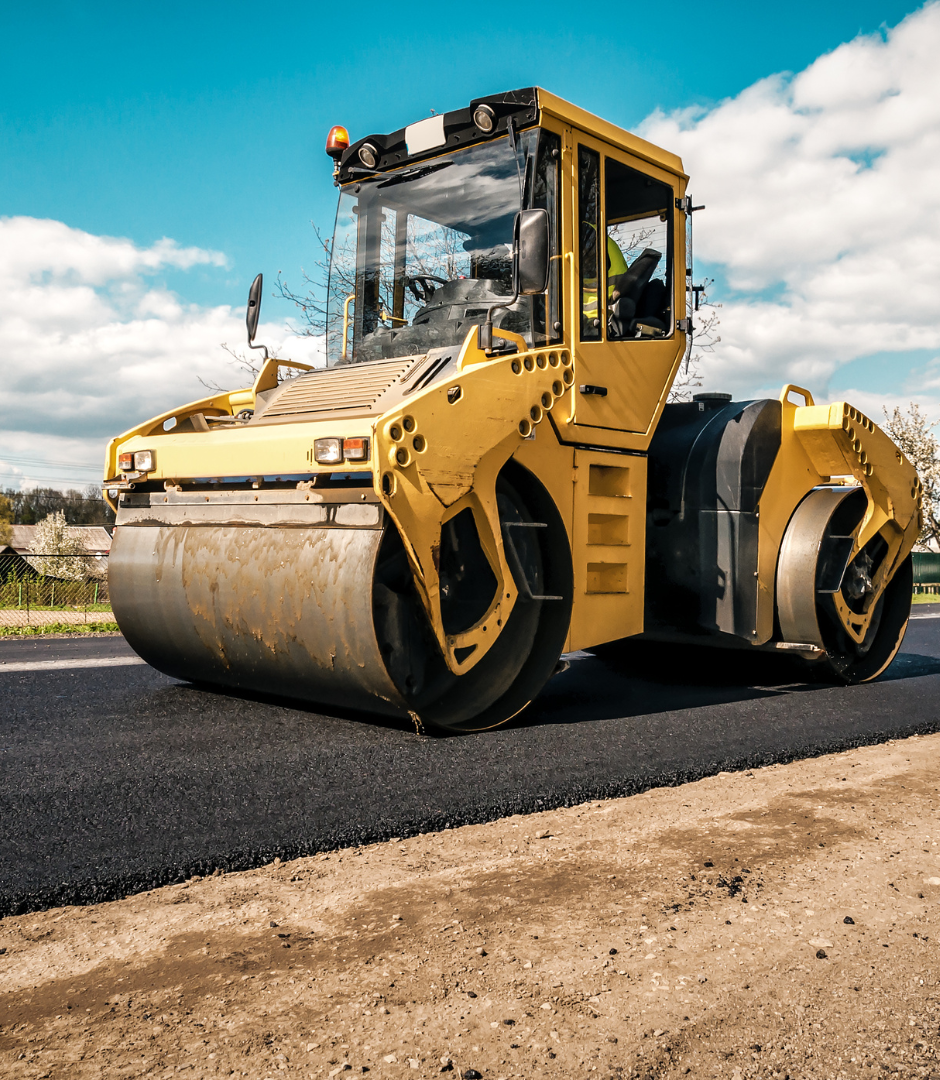
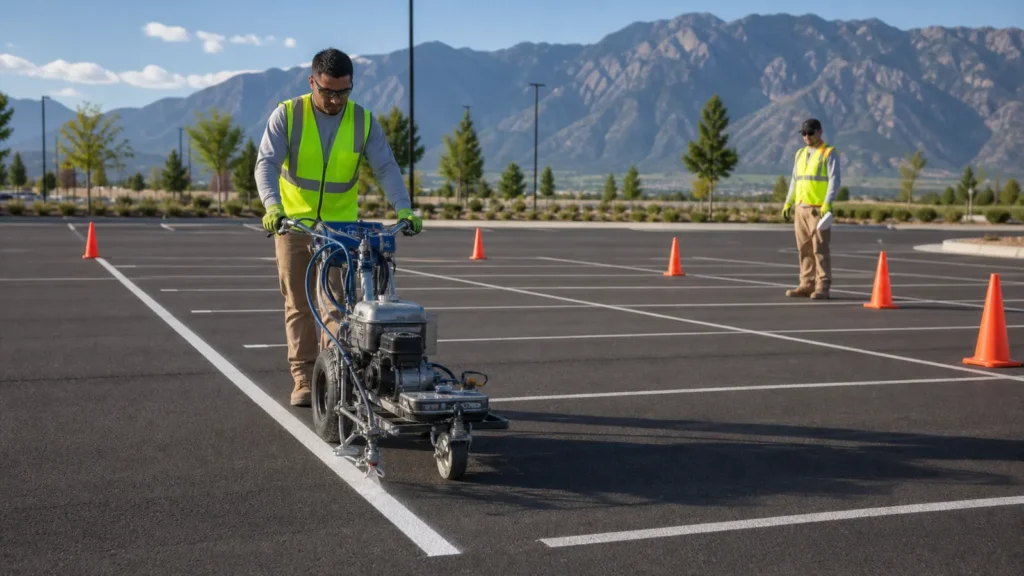
Effective parking lot striping in Draper, Utah begins with an approved, measured layout—not with a paint machine. Straight stall lines help organize vehicles, but a complete pavement-marking plan also considers drive aisles, accessible parking and routes, pedestrian crossings, loading, curbs, fire access, entrances, traffic direction, snow operations, and the way the property is actually used.
For 2026 budgeting, one current Utah contractor guide lists many small restriping projects around $300–$900, medium commercial lots around $900–$2,500, and large projects from $2,500–$6,000 or more. Another Utah contractor publishes standard painted stalls around $15–$25 each, with unit rates for lines and stencils. These are contractor-published examples, not independent market averages or an 801 Asphalt price list. Layout work, surface cleaning, old-mark removal, mobilization, materials, phasing, traffic control, stencils, curbs, and nighttime scheduling can materially change a quote.
801 Asphalt provides a detailed, scope-matched quote and aims to stay competitive for comparable Utah work. Ask for the approved plan, quantities, line widths, material system, preparation, and exclusions in writing so each proposal prices the same work.
Quick navigation
- Who striping is best for
- Restriping versus redesign
- Draper and ADA layout checks
- High-quality striping procedure
- 2026 Utah budgeting ranges
- Three practical questions
- Proposal checklist
Why the local layout matters in Draper
Draper parking areas serve hillside offices, medical practices, retail centers, restaurants, schools, churches, HOAs, multifamily communities, warehouses, and commuter-oriented properties. Grade, snow storage, delivery vehicles, peak traffic, drive-through queues, pedestrian paths, and sight distance vary among those uses. Repainting faded lines without checking these conditions can preserve a layout that no longer fits the property.
Draper City Code section 9-25-070 currently states that standard parking spaces are at least nine feet wide by eighteen feet deep. It also addresses angled and parallel spaces, loading and queuing spaces, nonresidential drive aisles, and limited compact parking on qualifying sites. The code directs ADA accessible parking design to the adopted building and fire code. Those provisions do not mean every maintenance repaint needs a new land-use approval, but they do mean an owner should verify the approved site plan before changing stall count, angle, circulation, compact-space placement, or accessible features.
This article is a planning guide, not a site-plan approval or accessibility certification. Building use, prior approvals, site geometry, current code, and field slopes can affect the correct solution. When the work changes more than paint visibility, coordinate with the property designer and the applicable Draper planning, building, engineering, or fire authority.
Who is parking lot striping best for?
Professional line striping and commercial parking lot maintenance are commonly a good fit for:
- Retail and restaurant properties that need clearer stalls, pedestrian paths, arrows, loading zones, and customer circulation.
- Medical and professional offices where accessible parking, access aisles, passenger loading, and a safe route to the entrance deserve special review.
- HOAs and multifamily communities coordinating resident parking, guest stalls, no-parking areas, mail or amenity access, and phased closures.
- Schools, churches, and recreation facilities with peak-use periods, crossings, drop-off activity, and large areas that can be scheduled during low occupancy.
- Warehouses and light-industrial properties separating passenger parking from truck approaches, docks, fire access, and equipment zones.
- Property managers repainting after sealcoating, patching, or an overlay, when the approved layout has been preserved or formally updated.
- Owners documenting stall counts and marking conditions in a preventive-maintenance plan.
Striping is not ready to begin when asphalt is failing, wet, dusty, oily, or still curing from a coating operation. Paint will not stabilize a pothole, correct excessive accessible-space slope, widen a deficient aisle, move a curb ramp, or resolve a conflict between the approved plan and field conditions. Structural repair, drainage correction, concrete work, or design review may need to come first.
Restriping or a new layout?
Restriping generally follows a known, accepted layout. Existing lines are visible enough to locate, stall count and circulation still work, accessible features remain correct, and no site change has made the pattern obsolete. The contractor cleans the surface, verifies key dimensions and control points, masks or removes confusing remnants where needed, and restores the markings.
A new parking stall layout requires more planning. It may be appropriate after resurfacing removes the old pattern, a tenant changes the use, islands or entrances move, parking demand changes, accessible spaces are relocated, compact stalls are introduced, fire access changes, or old lines create conflicts. The owner should provide the approved site plan or obtain professional layout direction. A striping crew should not be expected to make land-use, fire-code, or accessibility decisions from memory while paint is already in the machine.
Old markings also matter. If a redesign shifts stalls or arrows, ghost lines can confuse drivers, especially at night or when the pavement is wet. Blackout paint may remain visible as a dark stripe and can weather differently from surrounding asphalt. Grinding or another removal method can scar pavement. Sealcoating can provide a uniform field when the asphalt is a suitable candidate, but it adds cure time and is not a structural repair. The proposal should explain how obsolete markings will be treated and what visual result to expect.
Draper and accessible parking layout basics
The U.S. Department of Justice's 2010 ADA Standards establish scoping and technical requirements for accessible parking at covered facilities. The required count is calculated for each parking facility. At least one of every six required accessible spaces must be van accessible. Accessible spaces must be on the shortest accessible route to an accessible entrance, subject to the standards' detailed rules.
For marked spaces, the federal standard measures widths from the centerlines of markings except at certain outer boundaries. A car space is at least 96 inches wide. A van space is at least 132 inches wide with an adjacent compliant access aisle, or it may be 96 inches wide when its access aisle is at least 96 inches wide. Access aisles are generally at least 60 inches wide, extend the full length of the space, adjoin an accessible route, and are marked to discourage parking. The parking space and access aisle must be essentially level, with slope no steeper than 1:48 in all directions. Van spaces, aisles, and their vehicular route also have vertical-clearance and sign requirements.
Those requirements extend beyond a blue stencil. Surface dimensions, slope, route, curb-ramp position, signs, vertical clearance, count, dispersion, and entrance relationship all matter. Accessible parking markings should therefore be applied from a verified layout. A paint symbol on a steep or disconnected area does not create compliance.
Draper's code also limits compact parking to qualifying sites and requires compact spaces to meet stated dimensions, location, approval, and surface-marking conditions. Do not convert standard stalls to compact spaces solely to gain capacity without checking the approved site plan and current city requirements.
A high-quality parking lot striping procedure
1. Confirm the owner-approved scope
Gather the approved site plan, prior striping plan, accessible parking information, and any fire-authority direction. Count stalls and list lineal footage, arrows, stop bars, crosswalk bars, hatch areas, curbs, loading zones, stencils, and removals. State whether the work is exact restriping or a new layout. Identify who approves field changes.
2. Inspect pavement and previous markings
Document cracks, potholes, raveling, patches, ponding, oil, loose coating, and incompatible old paint. Check whether repaired or sealcoated areas have cured enough for the selected marking material. If deterioration affects line placement or accessible slopes, pause the striping scope and resolve the underlying condition.
3. Plan closures and maintain safe access
Coordinate tenants, deliveries, trash service, residents, emergency access, customer entrances, and alternate accessible routes. Use cones, barricades, spotters, and phased work appropriate for the lot. The crew needs an empty, controlled application lane; painting between moving vehicles produces both safety and quality problems.
4. Clean and prepare the surface
Remove dirt, sand, leaves, loose aggregate, deicing residue, and failing paint. Treat oil or contamination that can prevent bonding. Preparation methods should protect nearby vehicles, buildings, landscaping, drains, and pedestrians. The surface must be dry enough for the specified material.
5. Establish control points and verify dimensions
Lay out baseline points from the approved plan, then verify stall width, depth, angle, aisle, end islands, crossings, and accessible features before production painting. Recheck the first several stalls rather than multiplying an early measurement error across an entire row. On sloped or irregular Draper sites, field geometry may reveal a conflict that needs owner or designer direction.
6. Select material and weather conditions
Waterborne traffic paint is common for routine parking stalls. Other systems, including thermoplastic striping, may be considered for particular wear, cure, or specification needs. Material selection should account for the existing substrate, prior coating, traffic, temperature, moisture, manufacturer instructions, and owner requirements. A more expensive material does not compensate for a dirty surface or poor layout.
7. Apply straight, uniform markings
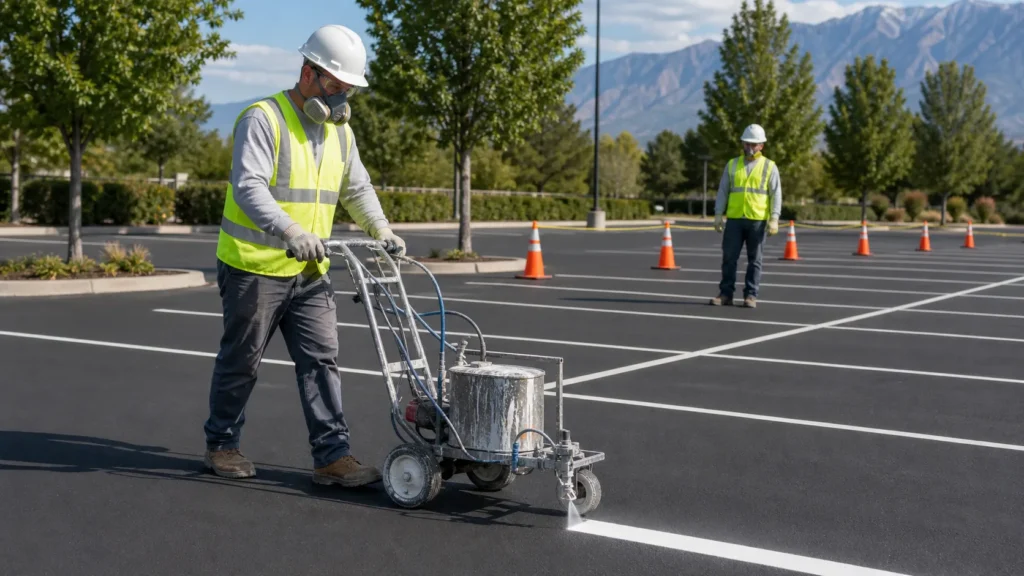
Set the striping machine for the specified line width and film placement. Maintain a steady speed, consistent gun height, straight alignment, clean starts, and neat endpoints. Use suitable templates for approved stencils and protect surrounding pavement from overspray. Apply multiple colors or elements in a sequence that prevents tracking and keeps the work zone understandable.
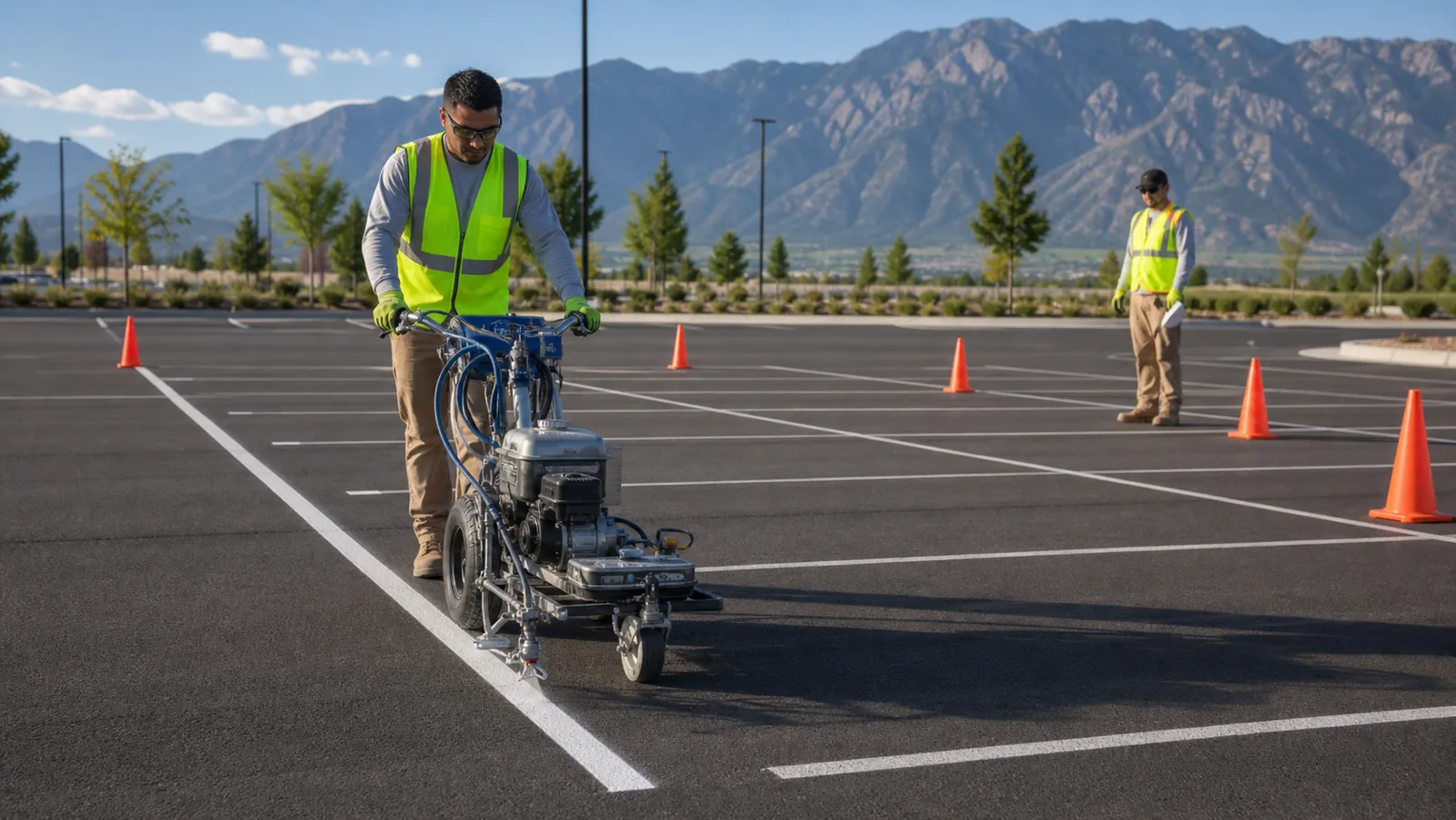
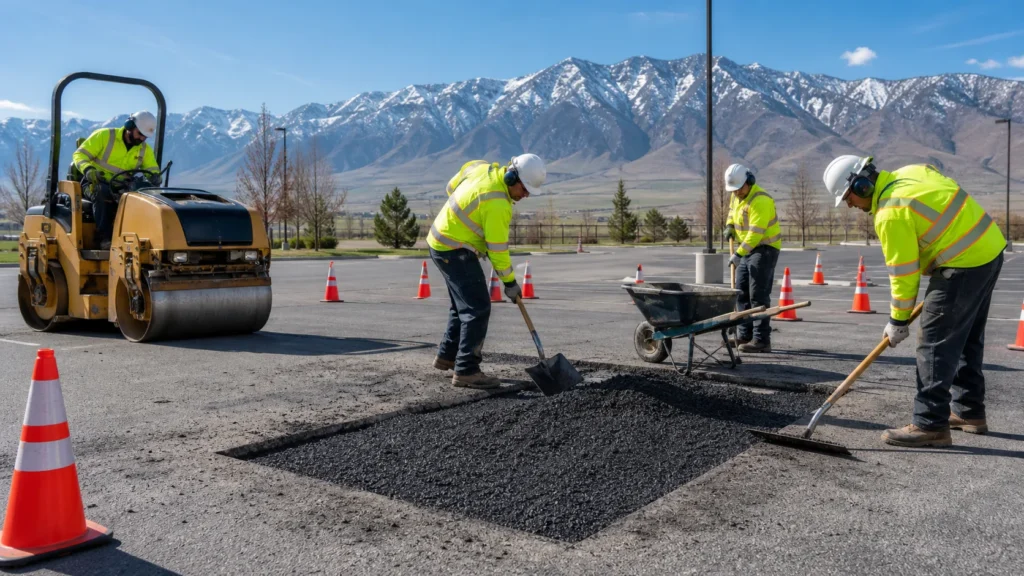
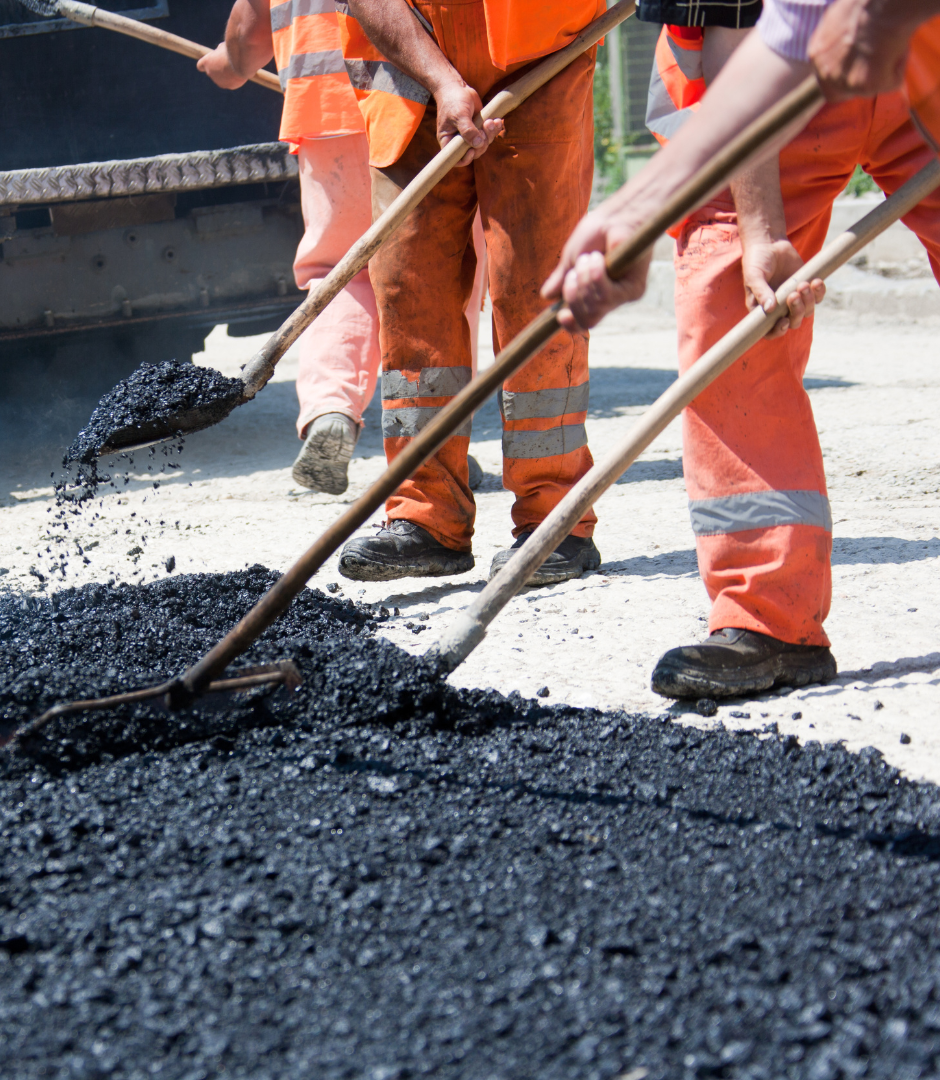
Original AI-assisted illustration of a representative controlled line-striping operation. It is not a photograph of an 801 Asphalt project.
8. Inspect alignment, coverage, and the full layout
Quality control is more than admiring one bright line. Check line width, straightness, spacing, endpoint consistency, coverage, overspray, missed areas, stencil orientation, ghost-line confusion, and the relationship among stalls, aisles, curbs, signs, and routes. Compare the completed pattern with the owner-approved plan before removing all control points.

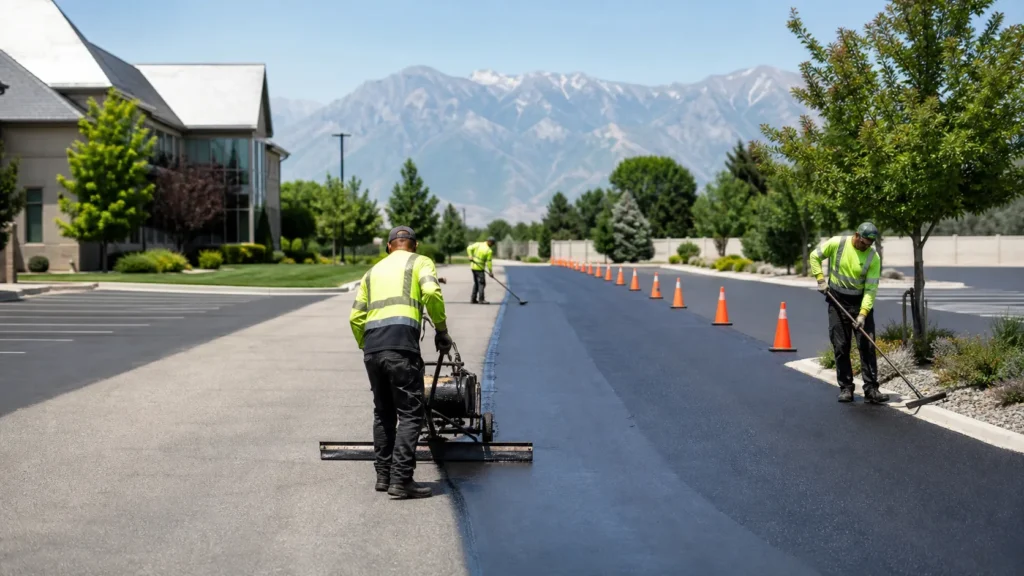
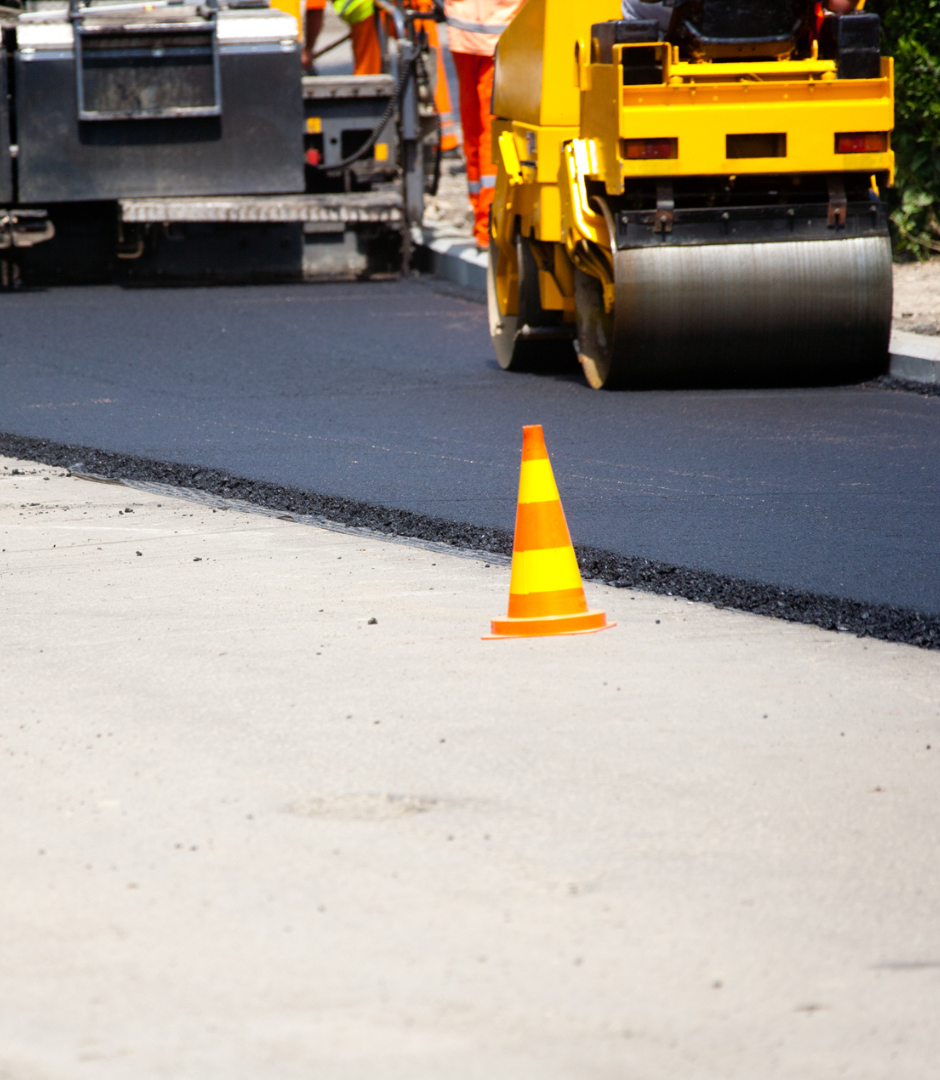
Original AI-assisted illustration of representative line-width and alignment inspection. It is not a photograph of an 801 Asphalt project.
9. Cure, reopen, and document
Keep vehicles and pedestrians off wet markings for the material- and weather-specific cure period. Cool temperatures, shade, humidity, heavy film, or a recently coated surface can extend reopening. At closeout, provide the completed quantities, material, colors, plan revision, weather, excluded repairs, cure guidance, and photographs. Preserve the approved layout for the next maintenance cycle.
2026 parking lot striping costs in Draper
The following Utah contractor-published examples were checked August 25, 2026. They are not government schedules, independent averages, guaranteed market rates, or quotes from 801 Asphalt.
| Striping item | Published Utah planning range | Unit | Common cost drivers | Source |
|---|---|---|---|---|
| Small lot restriping | About $300–$900 | project | Mobilization, stalls, cleaning, layout, access | Eckles Paving Utah 2026 striping guide |
| Medium commercial lot | About $900–$2,500 | project | Quantity, stencils, phasing, traffic control | Eckles Paving Utah 2026 striping guide |
| Large parking lot | About $2,500–$6,000+ | project | Layout scale, multiple phases, material, scheduling | Eckles Paving Utah 2026 striping guide |
| Standard painted stall | About $15–$25 | stall | Assumes clean pavement and stated contractor conditions | Black Canyon Exteriors Utah unit pricing |
| Standard thermoplastic stall | About $35–$55 | stall | Material system, surface suitability, mobilization | Black Canyon Exteriors Utah unit pricing |
| Four-inch traffic-paint line | About $0.30–$0.45 | linear foot | Clean surface, daytime schedule, quantity | Black Canyon Exteriors Utah unit pricing |
| Accessible-space marking | About $25–$75 | space marking | Stencil, paint, layout; does not price full compliance work | Eckles Paving Utah 2026 striping guide |
| Directional arrow | About $25–$100 | each | Size, stencil, paint, layout | Eckles Paving Utah 2026 striping guide |
| Fire-lane striping example | About $1–$3 | linear foot | Curb, wording, material, authority requirements | Eckles Paving Utah 2026 striping guide |
An “accessible marking” unit price usually addresses paint or stencil work; it does not mean the space, aisle, route, slope, sign, or count has been designed or certified. Likewise, a fire-lane unit price does not replace fire-authority direction. The written scope should separate layout verification from application.
Minimum charges make a five-stall touch-up cost more per stall than a large open lot. New layout, old-line removal, night work, traffic control, custom stencils, curbs, multiple colors, surface repairs, and return mobilization can all increase cost. Ask bidders to use the same quantity sheet before comparing totals.
Three practical Draper striping questions
When should a lot be restriped instead of redesigned?
Restripe when the approved configuration still suits the use and the control points, accessible features, circulation, and stall count remain valid. Seek a layout review when use or geometry changed, old lines conflict, accessible parking moves, compact stalls are proposed, or resurfacing erased the reference pattern. If the owner cannot produce an approved plan, recreating a faded layout from fragments can compound an old mistake.
What must be checked before marking accessible parking and access aisles?
Verify required count, van-space count, stall and aisle dimensions, slope, surface stability, location on an accessible route, entrance relationship, signs, vertical clearance, curb ramps, wheel-stop effects, and field obstructions. Then apply the approved ADA parking layout. The U.S. Department of Justice standards and applicable local codes should be read together; a stencil alone is not the compliance test.
How do paint, thermoplastic, traffic, weather, and surface condition affect service life?
Adhesion and wear depend on the selected material, pavement cleanliness, old coatings, application thickness, curing conditions, snowplows, tire turning, traffic volume, deicing operations, and UV exposure. Entrances, drive aisles, stop bars, and tight turns often wear faster than low-traffic stalls. The appropriate maintenance interval should be based on visibility and condition, not a promise that every line on the property will age identically.
Quality checklist for a striping proposal
Use this checklist when comparing pavement markings on Asphalt in Utah:
- Is the project exact restriping or a new layout?
- Is an approved plan identified, dated, and assigned to the owner or designer?
- Are stall count, lineal footage, line widths, colors, arrows, bars, curbs, and stencils quantified?
- Are accessible parking, access aisles, routes, signs, slopes, and vertical clearance verified by the appropriate party?
- Are fire lane striping and curb requirements based on current authority direction?
- Does the scope address old-line removal or ghost-line confusion?
- Are cleaning, oil treatment, repairs, and coating cure conditions included?
- Is the paint or thermoplastic system named with manufacturer application limits?
- Are traffic control, closures, phasing, notices, and alternate access assigned?
- Are straightness, width, coverage, spacing, and endpoint checks documented?
- Are cure and reopening instructions tied to material and weather?
- Are exclusions, taxes, minimum charges, and return mobilization clear?
Start with the plan, then price the paint
Walk the site with the approved plan and note faded lines, changed uses, pedestrian paths, loading, snow storage, accessible features, damaged asphalt, and conflicting old markings. Decide which questions belong to the striping contractor and which require the property designer or city and fire authorities. Then request written, quantity-matched proposals.
Learn about 801 Asphalt's Utah line striping service, browse the Draper article hub, and review the related Draper guides for sealcoating before restriping and repairing failed pavement first.
Request a free project assessment or call (801) 277-4258. Ask for measured line quantities, layout responsibility, material, preparation, traffic control, curing, and exclusions so competing quotes address equivalent work.
Editorial disclosure
Author: 801 Asphalt Editorial Team
Technical review: Automated source, pricing, link, and claims validation completed August 25, 2026; no unverified local project claim was included.
Published and updated: August 25, 2026
AI assistance: AI assisted with drafting and the two original illustrations. The images are representative scenes, not photographs of 801 Asphalt projects.
Sources and review notes
- Draper City Code section 9-25-070, Parking Dimensions
- Draper City Planning and Development
- U.S. Department of Justice 2010 ADA Standards for Accessible Design
- ADA.gov accessible parking topic guide
- Eckles Paving Utah 2026 striping cost guide
- Black Canyon Exteriors Utah striping unit pricing
- 801 Asphalt line striping service
Sources and prices checked August 25, 2026. Contractor-published figures are market examples, not government schedules, independent averages, an 801 Asphalt price list, or guaranteed quotes. This planning article is not a site-plan approval, accessibility certification, or legal opinion. No unverified project-history, ranking, licensing, warranty, lowest-price, or local-experience claim is included.