For asphalt crack sealing draper utah, the useful first answer is not a universal price or a cosmetic promise. Crack sealing keeps water and incompressible debris out of suitable working cracks. Routing, cleaning, dryness, sealant selection, installation temperature, recess or overband geometry, traffic control, and pavement condition determine value. Draper combines hillside and bench properties with HOAs, medical offices, schools, technology and office sites, retail centers, and commuter traffic. Steep grades, geotechnical conditions, storm drainage, irrigation, and high-elevation weather exposure can determine whether a pavement treatment succeeds.
Current Utah contractor-published planning examples place this work around about $1–$3 per linear foot in current Utah planning guides; one Utah contractor publishes roughly $0.50–$1.50 per linear foot for commercial work, with mobilization, routing, cleaning, crack width, quantity, and traffic control affecting the bid. Those figures are not government schedules, independent averages, guaranteed prices, or an 801 Asphalt rate card. A site visit can change the scope because quantity, existing condition, drainage, access, mobilization, materials, traffic control, weather, and required testing all affect cost.
801 Asphalt provides a detailed, scope-matched quote and aims to stay competitive for comparable Utah work. Invite each bidder to price the same map, quantities, assumptions, preparation, materials, quality checks, and exclusions; then ask for a written comparison when another proposal appears lower.
Quick navigation
- Who this service fits
- Draper planning conditions
- Method selection
- High-quality procedure
- 2026 Utah budgeting ranges
- Niche questions
- Quote checklist
Property fit and unsuitable cases
Professional crack sealing is commonly a good planning fit for:
- parking lots with discrete working cracks and useful surrounding pavement.
- private roads and HOA streets scheduled before winter moisture.
- commercial properties grouping crack work before sealcoating.
- driveways with suitable cracks but no widespread structural failure.
- maintenance programs tracking crack growth by mapped area.
Hot-pour crack sealing does not rebuild alligator-cracked pavement, fill potholes, correct settlement, or stabilize moving base. Very fine nonworking cracks, wet or contaminated cracks, and broad failed areas may require a different treatment.
A high-quality recommendation may divide one property into several treatments. That is often more honest than forcing every square foot into a single scope. The estimator should explain what is being preserved, what is being repaired, what needs a capital solution, and what should simply be monitored.
Draper conditions that change the scope
Draper combines hillside and bench properties with HOAs, medical offices, schools, technology and office sites, retail centers, and commuter traffic. Steep grades, geotechnical conditions, storm drainage, irrigation, and high-elevation weather exposure can determine whether a pavement treatment succeeds.
For crack sealing, the local angle in this batch is steep grades, hillside and geotechnical constraints, HOAs, retail and medical properties, commuter traffic, and Jordan River watershed protection. That combination calls for a written site map rather than a city-name assumption. Two properties in Draper can have different soils, drainage, traffic, utility history, shade, operations, and approved plans; the article therefore does not claim a universal municipal specification or prior 801 Asphalt project experience.
A Draper scope should trace water from the top of the paved area to its approved outlet, note retaining structures and utility corridors, and plan safe phasing on slopes. Accessible routes, deliveries, resident access, and emergency movement cannot be left to field improvisation once equipment occupies a constrained entrance.
Draper publishes drainage, street-improvement, geotechnical, SWPPP, and stormwater-quality resources. Regulated work must use the current applicable documents and approvals. For private projects, the same evidence-minded approach means documenting grades, support, drainage, traffic control, and material handling without inventing a municipal endorsement.
On a Draper hillside site, inspect both the paved surface and the slope relationships outside the proposed work. Water can enter at an uphill landscape edge and emerge beside a downhill curb, while a retaining structure or sensitive-area condition may limit excavation. Delivery vehicles can also drag or shove material at steep turns. A proposal should identify grade-control points, downhill containment, equipment access, and the person authorized to stop work if unexpected soil, seepage, or movement appears. Those controls are more useful than assuming every bench property behaves alike.
Before work, the owner should identify jurisdiction, property boundaries, public right-of-way, utility ownership, approved drainage, accessible routes, fire access, and any planned construction. Routine private maintenance and regulated public or development work are not interchangeable. When permits, engineered design, or approved-plan changes may apply, confirm them with the city and the appropriate licensed professional.
Choose the treatment from evidence
Crack type matters. Longitudinal, transverse, joint, edge, block, fatigue, reflection, and settlement cracking do not have identical causes. A condition map should identify cracks suitable for sealing and areas referred for patching, drainage work, or reconstruction.
Preparation controls adhesion. Dirt, vegetation, moisture, old loose filler, and incompressible debris prevent sealant from bonding to sound crack walls. Routing can create a defined reservoir when specified; it is not automatically appropriate for every crack or weak pavement edge.
Installation geometry and temperature must follow the material and crack condition. Excessive overband can track or catch plows; underfilling can leave an open channel; overheating can damage material; and traffic released before cooling can pull the sealant from the reservoir.
The decision record should be visible in the proposal. A low total can reflect a genuinely efficient scope, but it can also reflect less preparation, smaller quantities, thinner sections, omitted traffic control, or a treatment that does not address the failure. Price comparison becomes meaningful only after those differences are normalized.
The terminology that appears naturally in a thorough scope includes asphalt crack sealing, hot-pour crack sealant, crack routing, parking lot crack repair, driveway crack sealing, working cracks, pavement water intrusion, freeze-thaw cracking, commercial pavement maintenance, linear foot crack sealing cost, Utah asphalt maintenance, joint sealing, Asphalt in Utah. These phrases describe decisions and work elements; repeating them without useful explanation would not improve the project or the article.
High-quality procedure
1. Survey and classify cracks
Map length, width, orientation, movement, moisture, contamination, surrounding distress, drainage, and traffic. Separate suitable working cracks from fatigue areas, potholes, failed edges, and settlement that need other work.
2. Measure and price the actual scope
Estimate linear footage by area and crack class, identify routing or non-routing, list repairs performed first, and state mobilization, traffic control, material, and exclusions. Avoid vague lump sums without a map.
3. Schedule a dry workable window
Check pavement and air temperature, recent moisture, forecast, shade, and overnight conditions. Coordinate irrigation and closures so cracks stay dry and traffic remains out through cooling.
4. Route where specified
Use suitable equipment and reservoir geometry only on cracks selected for routing. Control dust and debris, protect weak edges, and keep routed material away from storm drains and occupied areas.
5. Clean and dry crack walls
Remove vegetation, loose filler, dust, and incompressible debris with appropriate tools. Use heat-lancing only under a safe approved method; do not trap visible moisture beneath hot material.
6. Heat and install sealant correctly
Use a compatible hot-pour product and controlled melter, following manufacturer temperature limits and agitation requirements. Fill the reservoir to the specified recess or overband without excessive spill.
7. Protect and inspect the work
Prevent vehicles and pedestrians from contacting hot material, use blotting material only when compatible, and inspect adhesion, continuity, geometry, missed cracks, tracking, and cleanup.
8. Record and monitor
Document product, lot, temperatures, footage, mapped areas, weather, routing, exclusions, and reopened time. Reinspect after a seasonal cycle and track cracks or failed areas that need structural treatment.
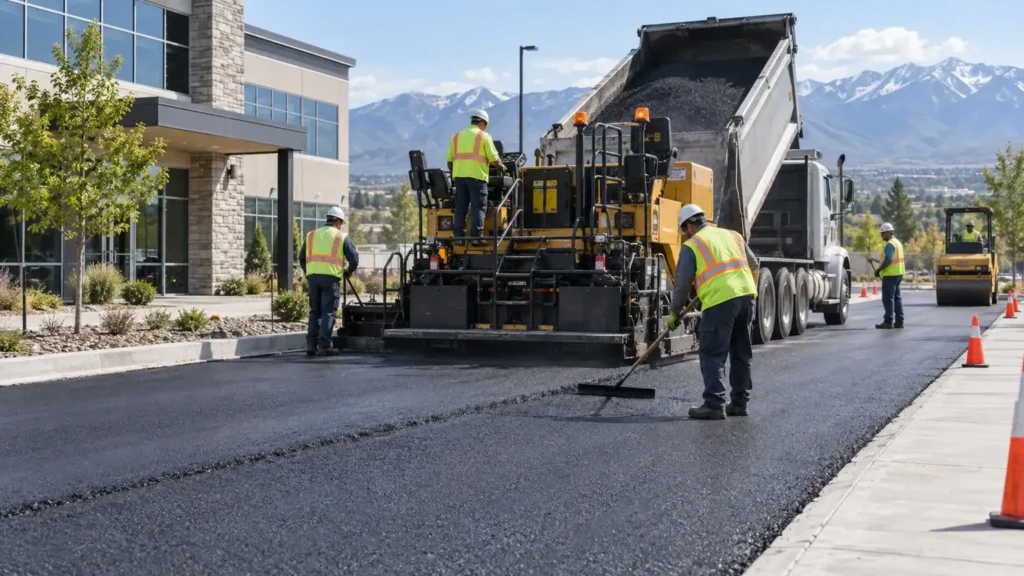
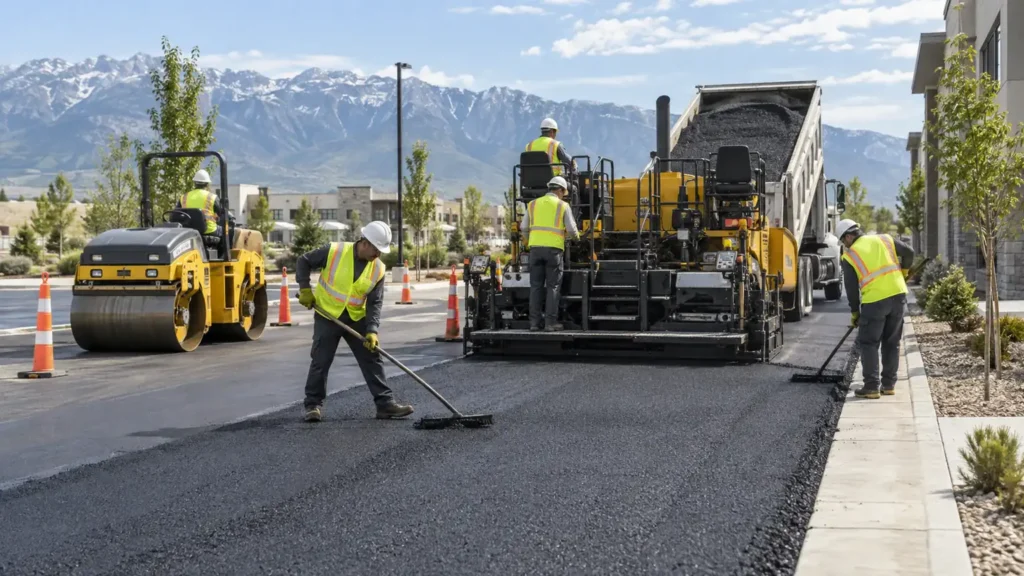
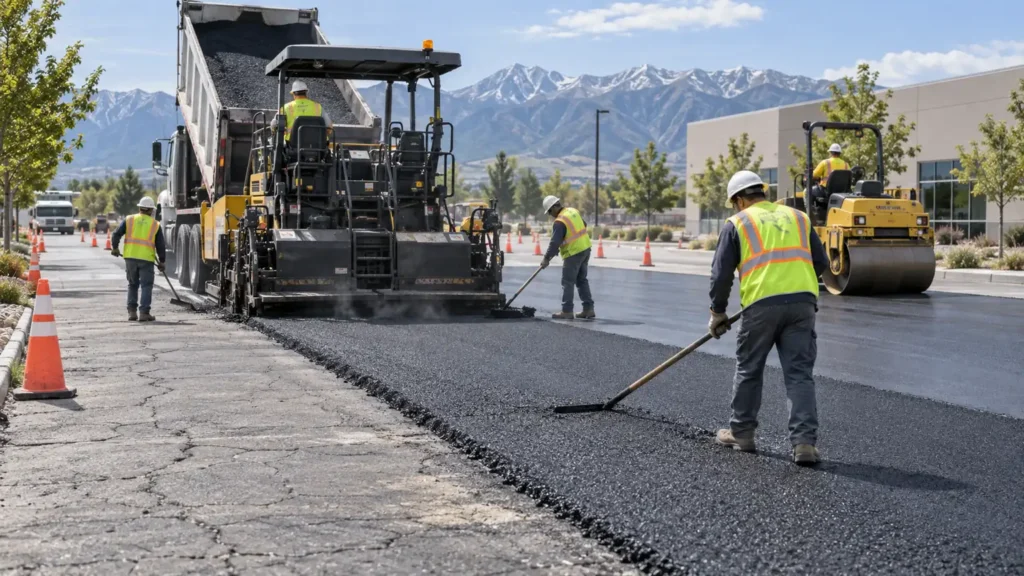
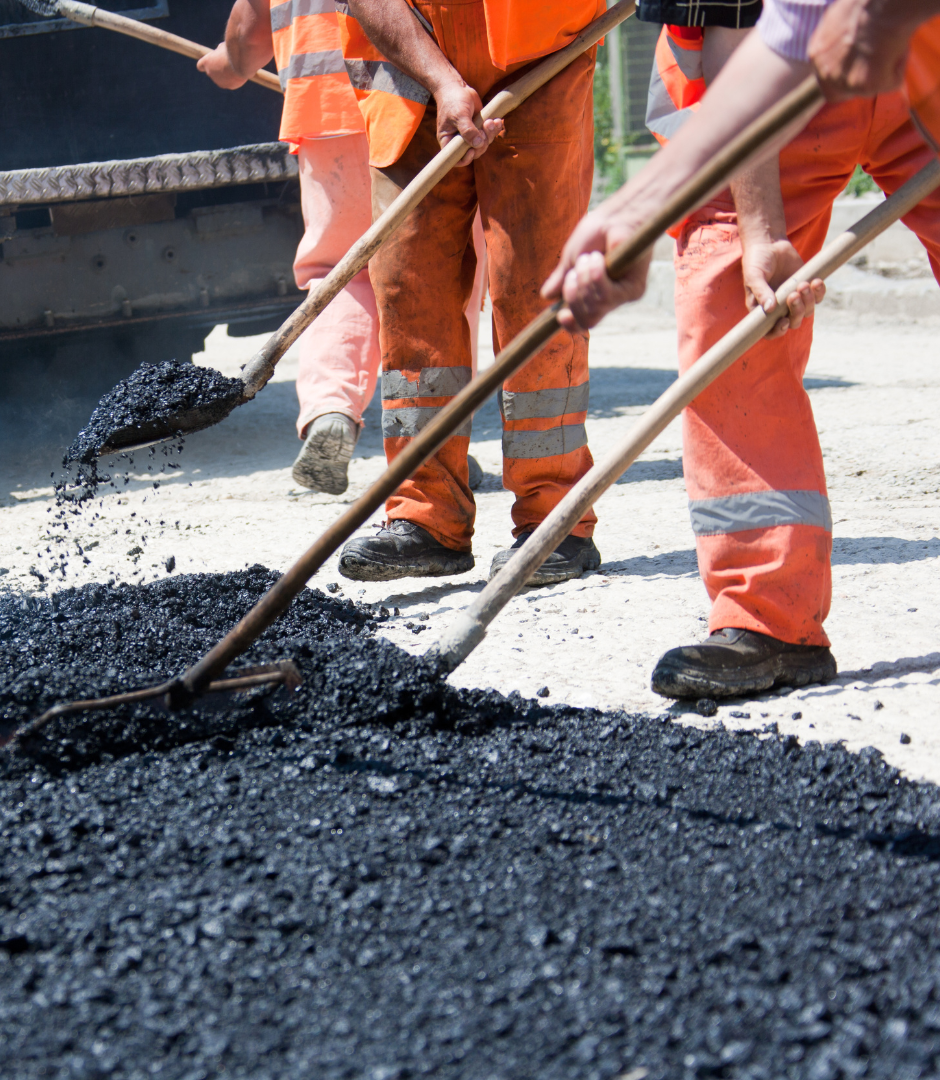
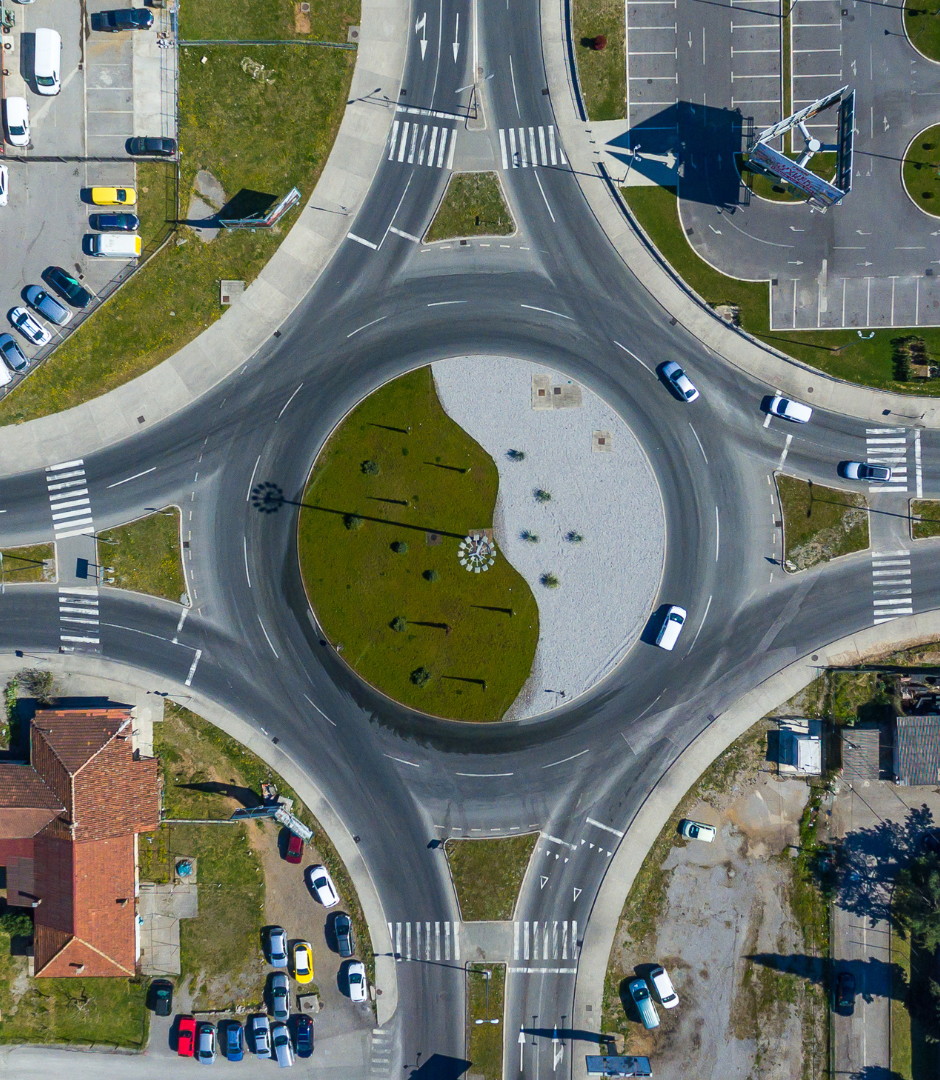
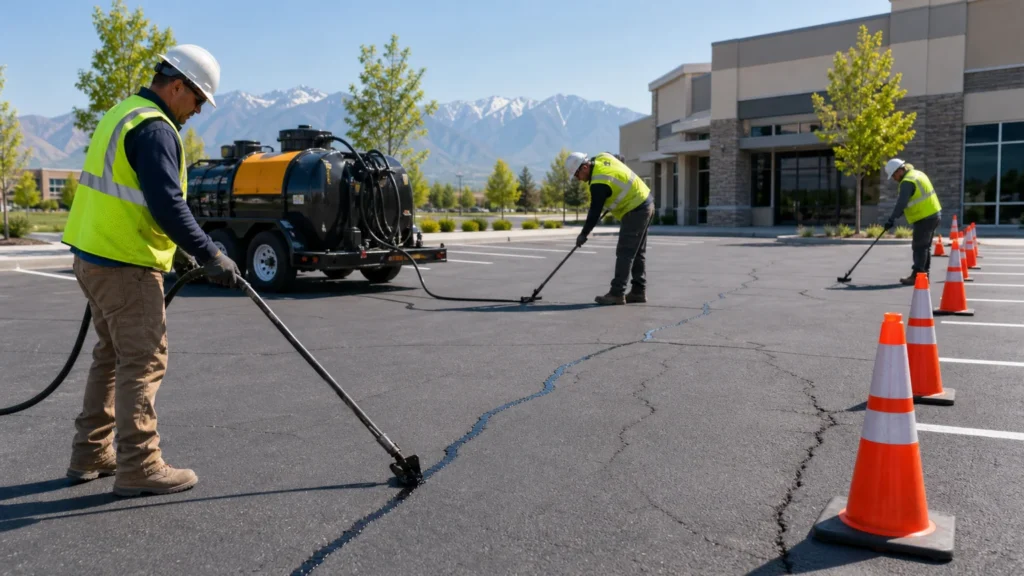
Original AI-assisted illustration of representative crack sealing work in Draper, Utah; not a photograph of an 801 Asphalt project.
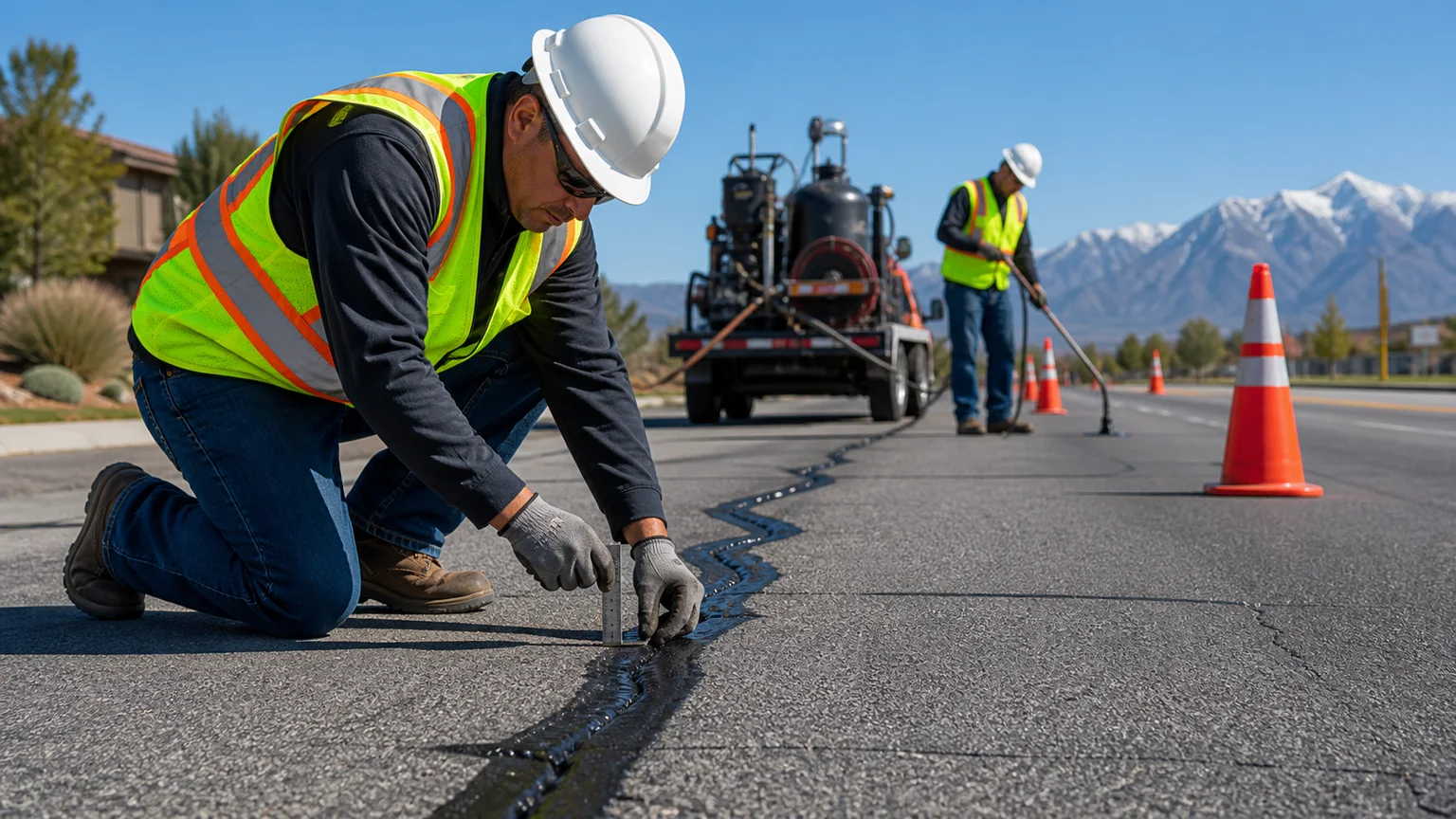
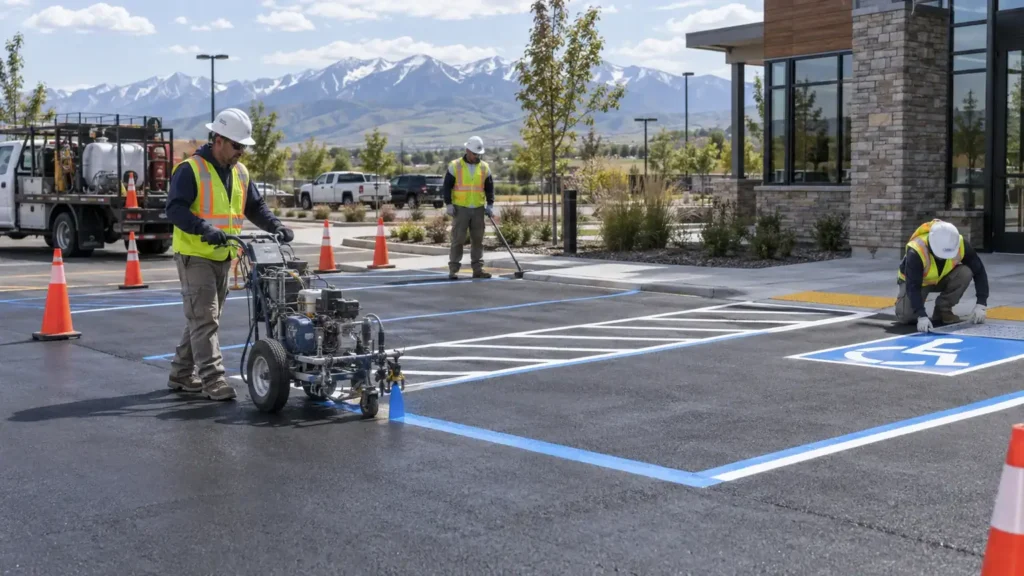
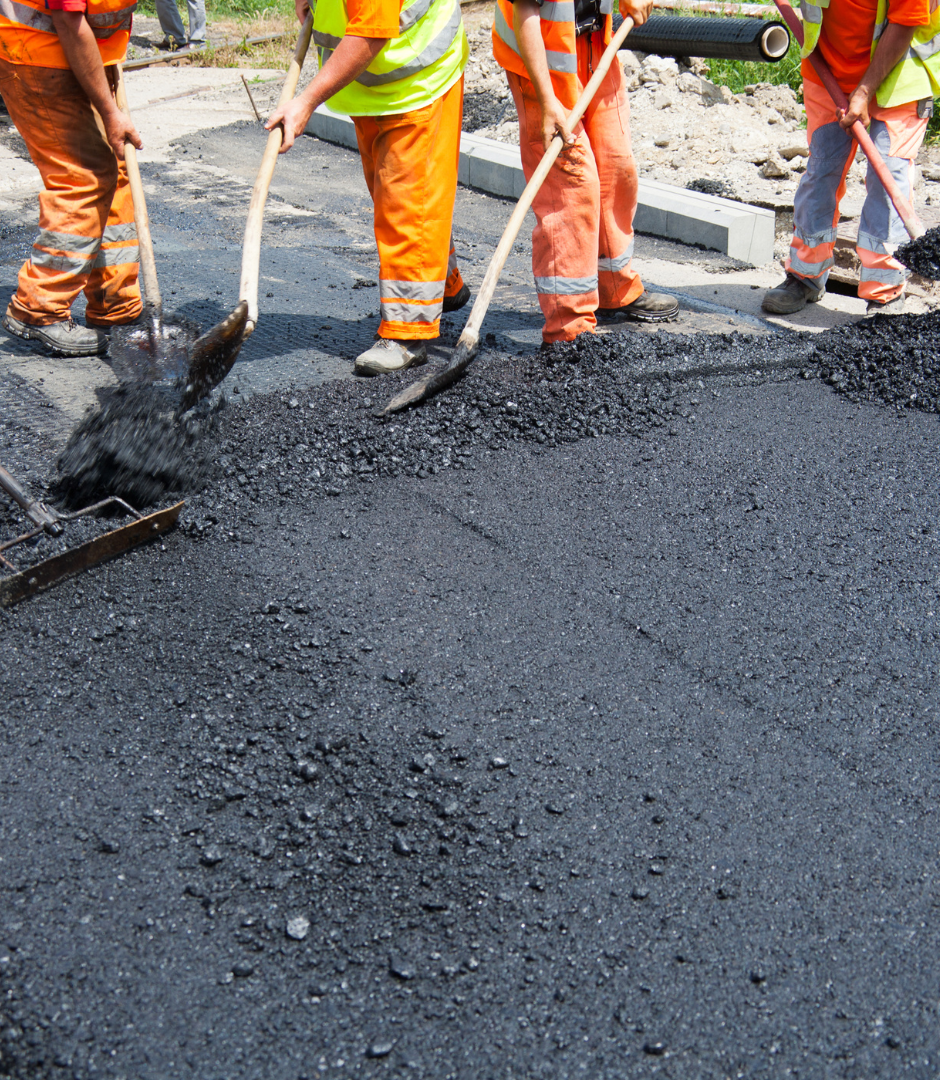
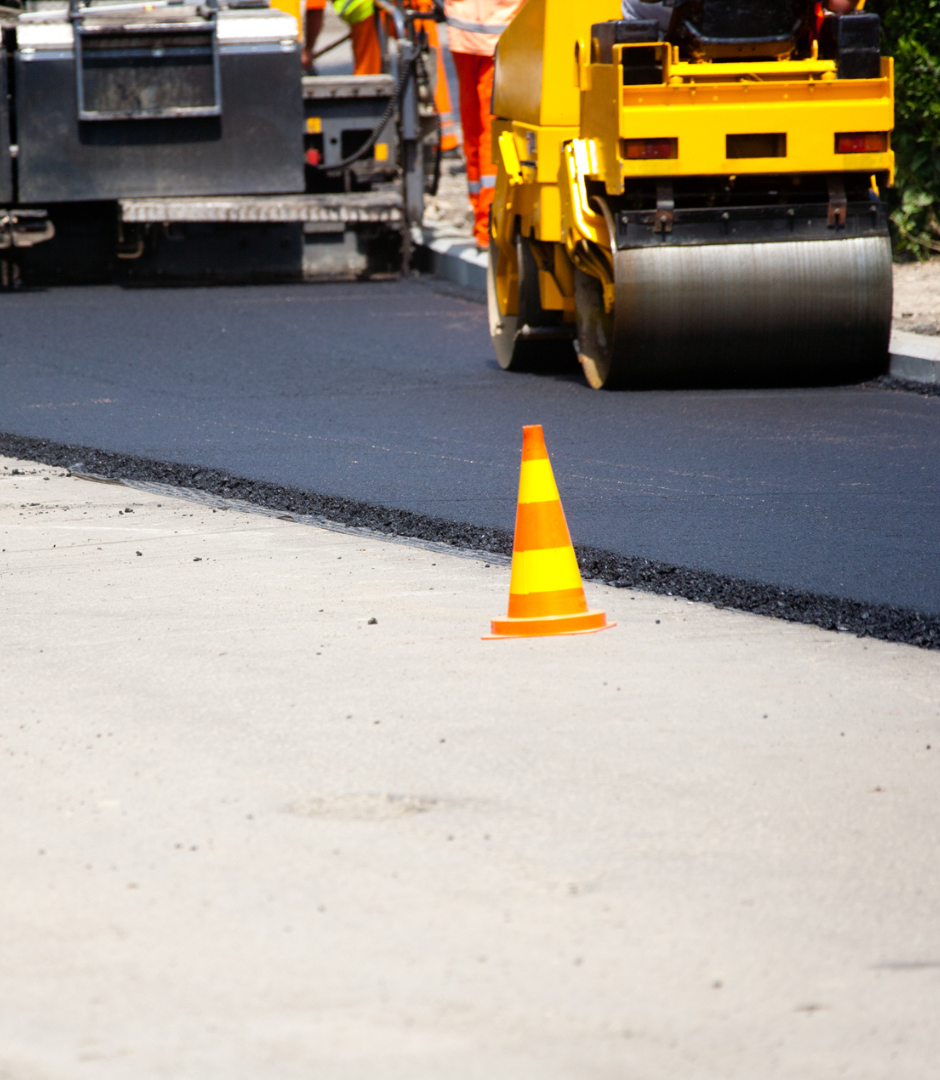
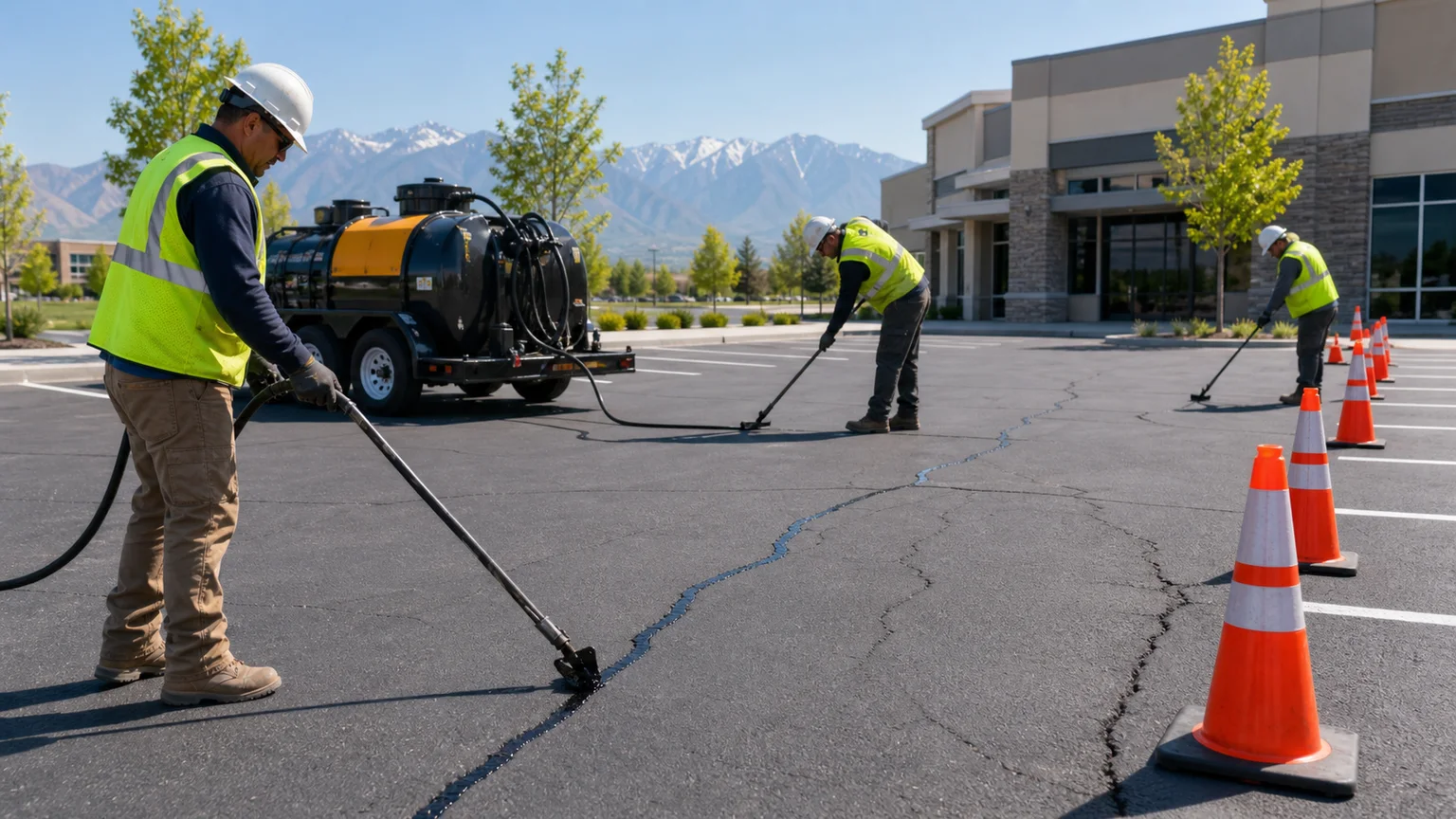
Original AI-assisted illustration of a representative crack sealing quality-control step in Draper, Utah; not a photograph of an 801 Asphalt project.
2026 crack sealing budgeting in Draper
The following current Utah contractor-published examples were checked August 25, 2026. They are starting points for budgeting—not quotes, a promise that every project falls inside the range, or evidence that one contractor is the cheapest.
| Scope | Published planning range | Unit | Major cost drivers | Source |
|---|---|---|---|---|
| Utah planning range | $1–$3 | linear foot | Size, access, preparation, traffic control, material and existing condition | 801 Asphalt paving cost guide |
| Utah commercial example | $0.50–$1.50 | linear foot | Size, access, preparation, traffic control, material and existing condition | 801 Asphalt paving cost guide |
| Sealcoating coordinated afterward | $0.20–$0.50 | square foot | Size, access, preparation, traffic control, material and existing condition | 801 Asphalt paving cost guide |
| Localized patching alternative | $2–$6 | square foot | Size, access, preparation, traffic control, material and existing condition | 801 Asphalt paving cost guide |
Small projects can carry a higher unit cost because crew, equipment, trucking, traffic control, and setup are spread across fewer units. Large or repeatable phases may gain efficiency, while tight access, night work, deep repair, drainage correction, specialty materials, public interfaces, testing, and several mobilizations can raise the total.
Ask for measured quantities and alternates. A useful proposal can show a base scope, priority repairs, optional phases, unit prices for uncertain conditions, and work that should be deferred. That structure makes an 801 Asphalt quote easier to compare with another Utah proposal without claiming a guaranteed lowest price.
Three Draper questions
Which cracks should not be sealed?
Fatigue or alligator cracking, deep settlement, failed edges, potholes, and wet or contaminated cracks need diagnosis and often repair. Sealing a shattered area does not restore its structure.
Is routing always necessary?
No. Routing can improve reservoir geometry for suitable cracks and specified systems, but crack width, movement, edge integrity, pavement condition, equipment, and material guidance determine whether it is appropriate.
When is the best Utah timing?
A dry period when cracks are sufficiently open, pavement meets product temperature limits, and the crew has enough cure and traffic-control time is preferable. Calendar season alone does not override moisture or product requirements.
Scope-matched quote checklist
Use this checklist when comparing crack sealing proposals for Asphalt in Utah:
- Are the work limits and quantities mapped rather than described only as “all needed areas”?
- Does the proposal identify suitable and unsuitable conditions for the treatment?
- Are preparation, materials, application or placement rates, thicknesses, and quality checks stated?
- Are drainage, utilities, irrigation, structures, edges, and existing failures addressed?
- Are pedestrian, accessible-route, delivery, resident, customer, and emergency needs planned?
- Are weather limits, cure or cooling requirements, barriers, and reopening authority clear?
- Are mobilization, traffic control, testing, disposal, taxes, and specialty work included or excluded?
- Are unit prices and change-order triggers provided for uncertain conditions?
- Will the contractor document materials, quantities, weather, photographs, and completed areas?
- Do competing bids use the same map, assumptions, and acceptance criteria?
Turn the site walk into a comparable plan
Walk the property with a numbered map and photograph drainage, structures, utilities, traffic paths, edges, and each proposed work area. Ask every bidder to identify suitable and unsuitable treatment areas and to state measurable preparation, materials, quality controls, cure or reopening rules, and exclusions. Written equivalence is what makes a price comparison fair.
Learn about 801 Asphalt's crack sealing service, browse the Draper asphalt article hub, and read the Draper asphalt repair guide and Draper sealcoating guide.
Request a free project assessment or call (801) 277-4258. Ask for a scope-matched written quote that separates quantities, preparation, materials, traffic control, quality checks, and exclusions.
Editorial disclosure
Author: 801 Asphalt Editorial Team
Technical review: Automated source, pricing, link, image, claims, and duplication validation completed 2026-08-26; no unverified project-history, licensing, warranty, ranking, lowest-price, or city-experience claim was included.
Published and updated: 2026-08-26
AI assistance: AI assisted with drafting and the two original illustrations. The images are representative scenes, not photographs of 801 Asphalt projects.
Sources and review notes
- https://www.draperutah.gov/business-development/engineering/design-standards-and-details/
- https://www.draperutah.gov/living-in-draper-city/utilities/water-and-storm-water/storm-water/storm-water-quality-and-pollution-prevention/
- 801 Asphalt paving cost guide
- 801 Asphalt crack sealing cost guide
- 801 Asphalt crack sealing cost guide
Sources and prices checked August 25, 2026. Contractor-published figures are market examples, not government schedules, independent averages, an 801 Asphalt price list, or guaranteed quotes. Applicable public or permitted work should be checked against current Draper requirements and approved plans.