The right asphalt repair in Eagle Mountain, Utah depends on the cause below the visible damage. A shallow pothole in otherwise stable pavement may be repaired with a properly prepared hot-mix patch. A recurring depression over a utility trench, connected alligator cracks, pumping, or pavement that moves under a truck often requires removal of failed asphalt and weak support. Filling the surface alone can conceal the reason the defect returned.
Current Utah contractor-published planning examples place many small surface pothole repairs around $100–$400 each, larger potholes with base repair around $400–$800, crack work around $1–$3 per linear foot, depressed-area patches around $3–$7 per square foot, and full-depth repairs around $6–$12 per square foot. Mobilization, depth, saw-cut geometry, base reconstruction, drainage, traffic control, hot-mix availability, and access can move the total substantially. These are budgeting references—not independent market averages or an 801 Asphalt price list.
801 Asphalt provides a detailed, scope-matched quote and aims to stay competitive for comparable Utah work. Ask every bidder to identify repair limits, assumed depth, base work, compacted asphalt thickness, materials, reopening, and hidden-condition changes so proposals can be compared on equal scope.
Quick navigation
- Who repair is best for
- Surface versus full-depth repair
- Utility trenches and construction access
- High-quality repair procedure
- 2026 Utah budgeting ranges
- Three niche questions
- Proposal checklist
Why diagnosis matters on growing Eagle Mountain sites
Eagle Mountain properties include newer subdivisions, large residential lots, schools, retail construction, private drives, HOA streets, and commercial pads that may still experience nearby development traffic. Pavement distress in those settings can result from ordinary aging, but it can also trace to an old utility trench, disturbed fill, repeated construction-truck loading, an unfinished shoulder, tracked soil, irrigation, or drainage that changed as adjacent work progressed.
Eagle Mountain City's Streets Department explains that its warm-season public-road repair practice uses subgrade material, compaction, and hot-mix asphalt, while winter work may rely on temporary road base and cold mix. The department also says new city construction standards use engineer-grade fill in utility trenches under or across roadways to reduce settlement. A private lot follows its own contract, but these public practices reinforce two useful distinctions: temporary material should be described honestly, and failed support should be corrected before a permanent surface is placed.
Open, wind-exposed sites add a preparation concern. Dust and loose aggregate can contaminate cut faces, tack surfaces, base, and hot mix. Water used for dust control must not leave the excavation saturated. The repair sequence should keep construction traffic off prepared areas and should account for the haul and placement window before the asphalt cools.
Who is a good fit for asphalt repair in Eagle Mountain?
Targeted parking lot repair or driveway repair can be a practical fit for:
- Newer retail or office properties with isolated settlement over a trench, around a utility lid, or beside a construction tie-in.
- Schools and churches that can phase repairs around lower-use periods while protecting bus, drop-off, and accessible routes.
- HOAs and multifamily communities prioritizing potholes, broken edges, drainage paths, and recurring defects before winter.
- Warehouses and contractor properties with localized failure along truck routes, entrances, gates, or loading approaches.
- Homeowners with one failed driveway panel or edge while surrounding pavement remains stable.
- Developers closing out construction access damage before final striping and turnover.
- Property managers building a multiyear repair map rather than repeatedly filling the most visible hole.
Repair is not always the economical treatment. Widespread alligator cracking, broad rutting, repeated settlement across many areas, extensive raveling, or a base that pumps under load can indicate that isolated patches will become a patchwork without solving the system-level failure. An overlay also needs sound support and workable elevations. Sealcoating is preventive surface protection, not structural repair. A broad reconstruction or engineered rehabilitation comparison may be more defensible when distress is no longer localized.
Surface patch or full-depth repair?
A surface patch addresses distress that is limited mainly to the asphalt layer and surrounded by stable pavement. It still requires removal of loose material, clean sound edges, compatible bonding treatment when specified, controlled material placement, and compaction. A cold patch may be useful for temporary hazard reduction when hot mix is unavailable, but it should not be sold as equivalent to a permanent structural repair.
A full-depth asphalt patch removes damaged pavement and unsuitable supporting material until stable conditions are reached. The base is rebuilt and compacted, grade and moisture are corrected, and hot mix asphalt patch material is placed in workable lifts. This method is commonly considered where a pothole returns in the same spot, connected cracking shows loss of support, a utility cut has settled, or excavation reveals wet, loose, contaminated, or poorly compacted base.
Repair boundaries should extend to sound pavement and form a shape that can be compacted. Tiny irregular edges are difficult to finish; unnecessarily large limits waste budget. A contractor should explain how visible distress, movement, trench history, and excavation findings define the limits. The change-order process should state what happens if the failed area is wider or deeper than it appears.
Utility trenches, fill, and construction traffic
A utility trench creates a narrow zone with different support history than the surrounding ground. Settlement may appear as two parallel cracks, a depressed strip, rocking pavement near a lid, or repeated breaks where the trench crosses a drive aisle. The surface symptom does not prove the exact cause, but it is a reason to investigate compaction, backfill, moisture, and pavement continuity instead of applying another thin patch.
Construction access can cause a different pattern. Heavy trucks may load a pavement section designed for passenger vehicles; tracked dirt can block drainage; turning can shove a warm or weak surface; and later trenching can cut newly completed asphalt. Owners should identify whether heavy construction use will continue after repair. A durable fix may need traffic control, a revised section, stabilized shoulders, or delayed final surfacing rather than simply thicker patch material.
Drainage belongs in the same discussion. Ponding inside a depression, runoff entering a broken edge, irrigation overspray, or a low utility frame can keep the repaired area wet. A patch should restore a functional surface, but it cannot correct a larger drainage system unless that work is in scope. Changes near public streets, storm systems, or right-of-way should be coordinated with Eagle Mountain City.
A high-quality asphalt repair procedure
1. Map the defect and investigate the cause
Record distress type, length, width, severity, movement, traffic, grade, water, nearby utilities, and prior repairs. Ask about construction history and when the defect first appeared. Mark repair limits as an initial assumption rather than pretending a surface view reveals every hidden condition.
2. Define purpose, depth, and access
The written scope should distinguish temporary hazard control from a durable structural patch. It should identify estimated depth, compacted asphalt section, base quantity, disposal, traffic control, phasing, utility locating, and reopening. Assign responsibility for private utilities and for approvals if work reaches a public connection.
3. Saw-cut and remove failed material
Establish straight boundaries in sound pavement where a full-depth repair is specified. Remove loose and failed asphalt without undermining adjacent edges. Continue excavation through saturated, contaminated, or unstable support as the contract permits. Keep dust, debris, and construction traffic away from the open repair.
4. Correct moisture, trench, and edge problems
Identify water sources and verify the excavation is suitable for rebuilding. Correct a broken edge, low grade, irrigation source, or unstable trench support within the agreed scope. Some findings require an engineer, utility owner, or city coordination. Document before covering the work.
5. Rebuild and compact aggregate base
Place suitable aggregate in manageable lifts, moisture-condition as required, and compact with equipment that reaches the center, perimeter, and corners. Verify depth and finished grade. A plate compactor may suit a confined repair; larger areas may use rollers. Pumping, deep movement, or soft edges are stop-and-correct conditions.
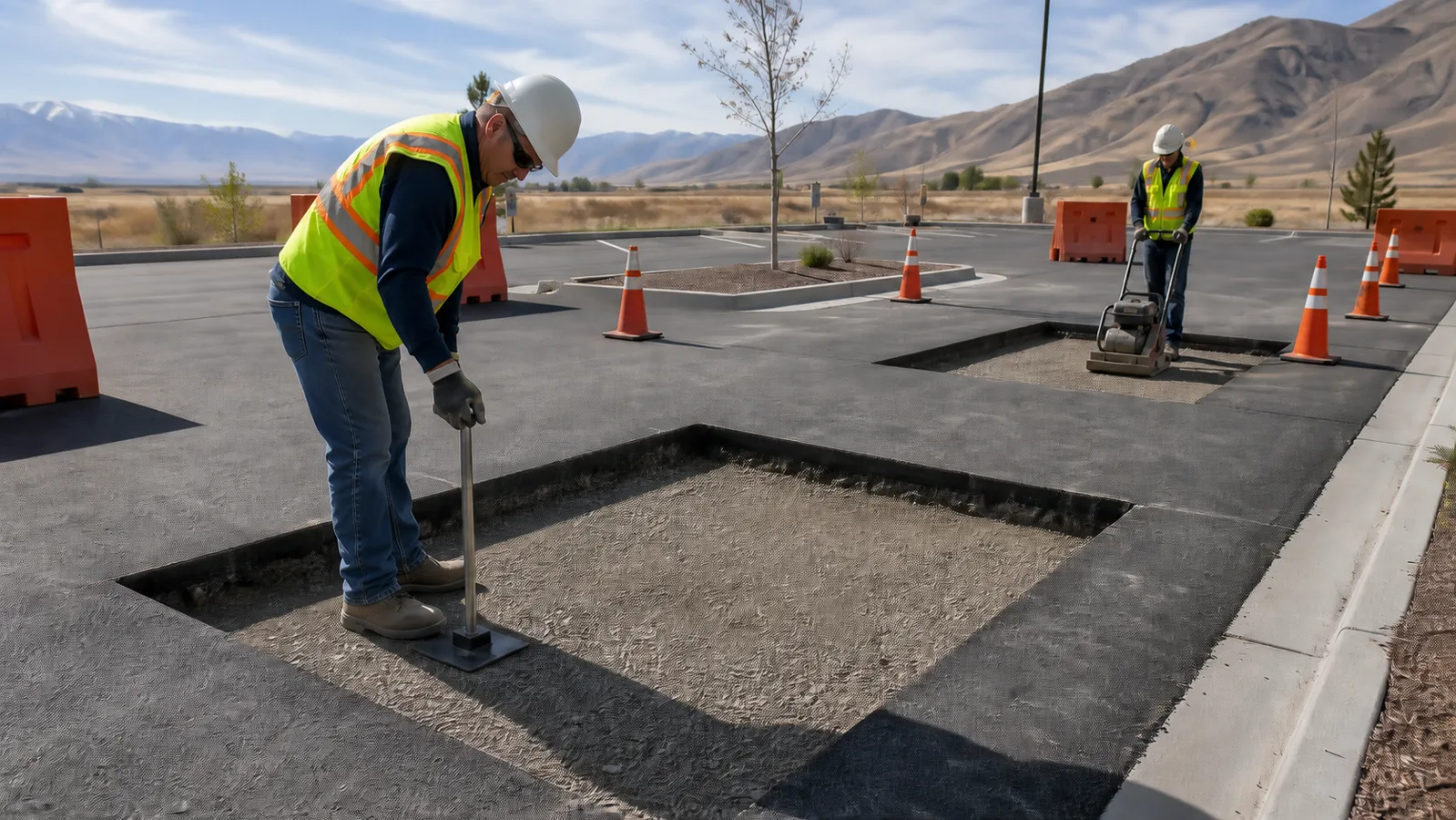
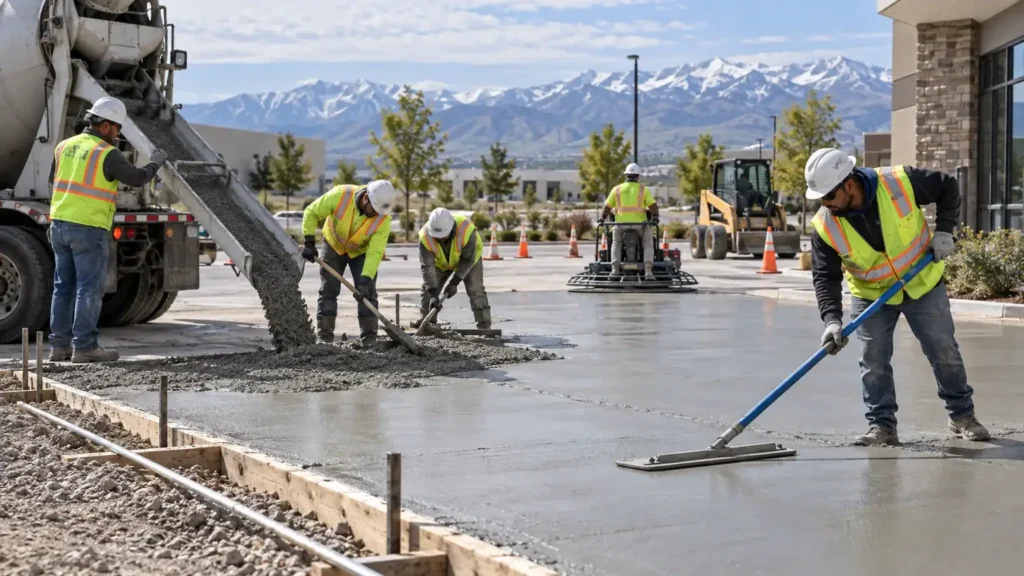
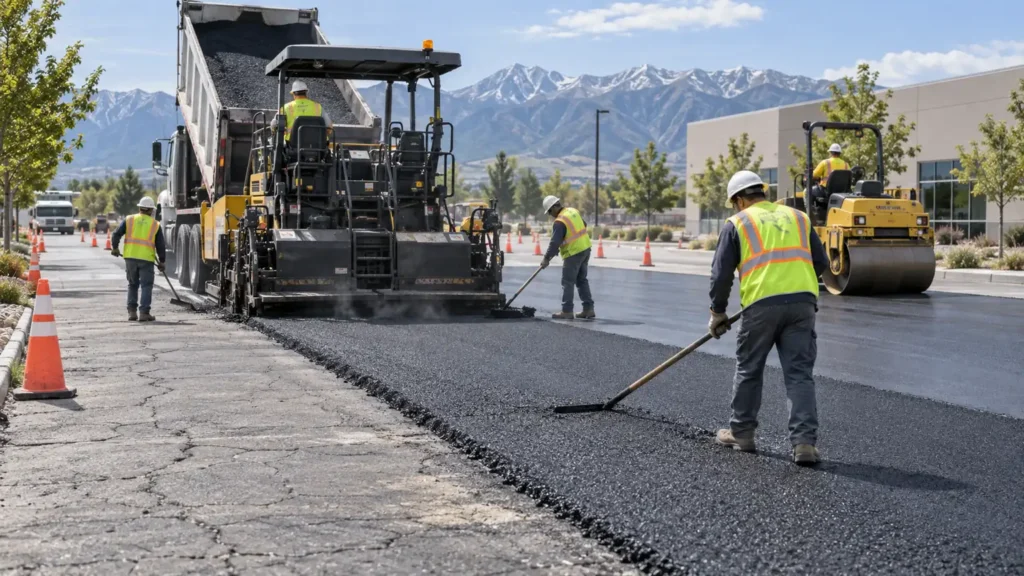
Original AI-assisted illustration of representative base reconstruction and compaction. It is not a photograph of an 801 Asphalt project.
6. Prepare faces and bonding surfaces
Clean vertical edges and surrounding pavement. Apply tack or another bond treatment where the specification calls for it, at the appropriate rate. Protect concrete, drains, utility lids, curbs, landscaping, and finished surfaces. Remove windblown dust before the hot mix arrives.
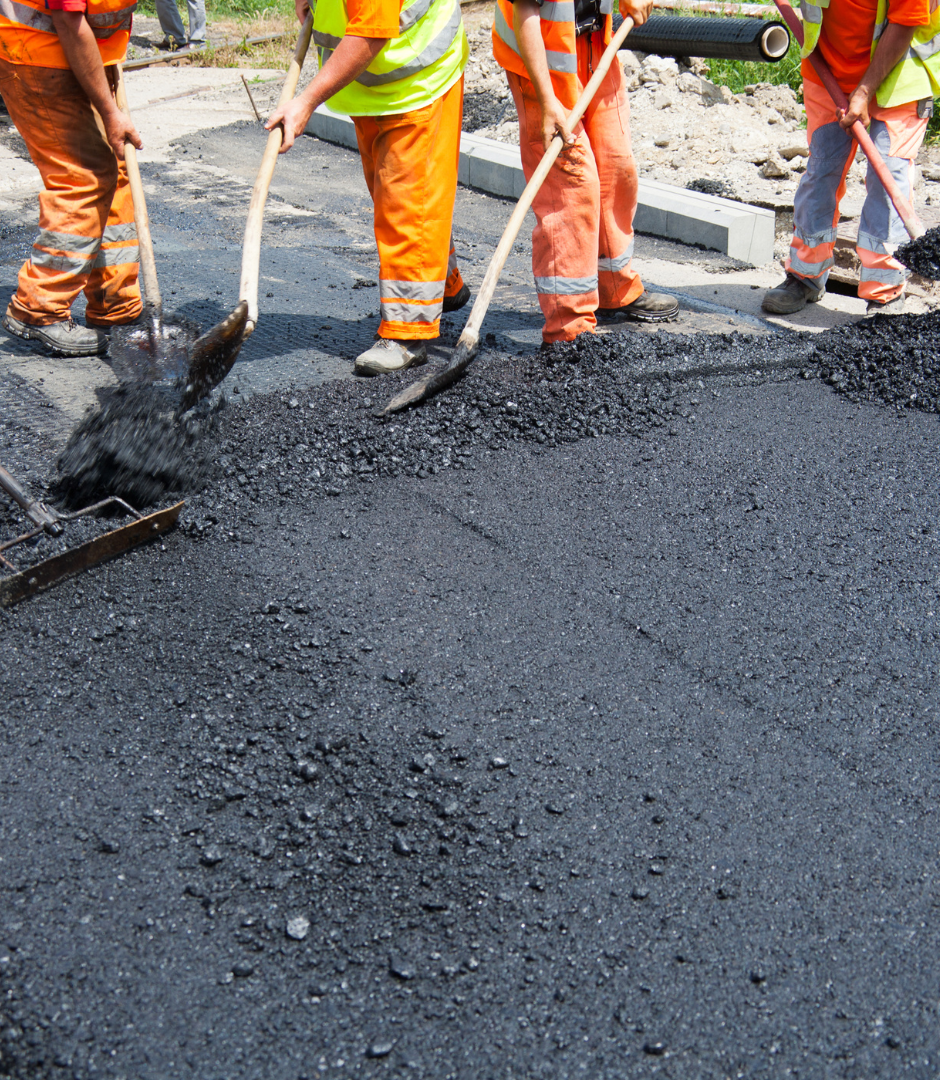
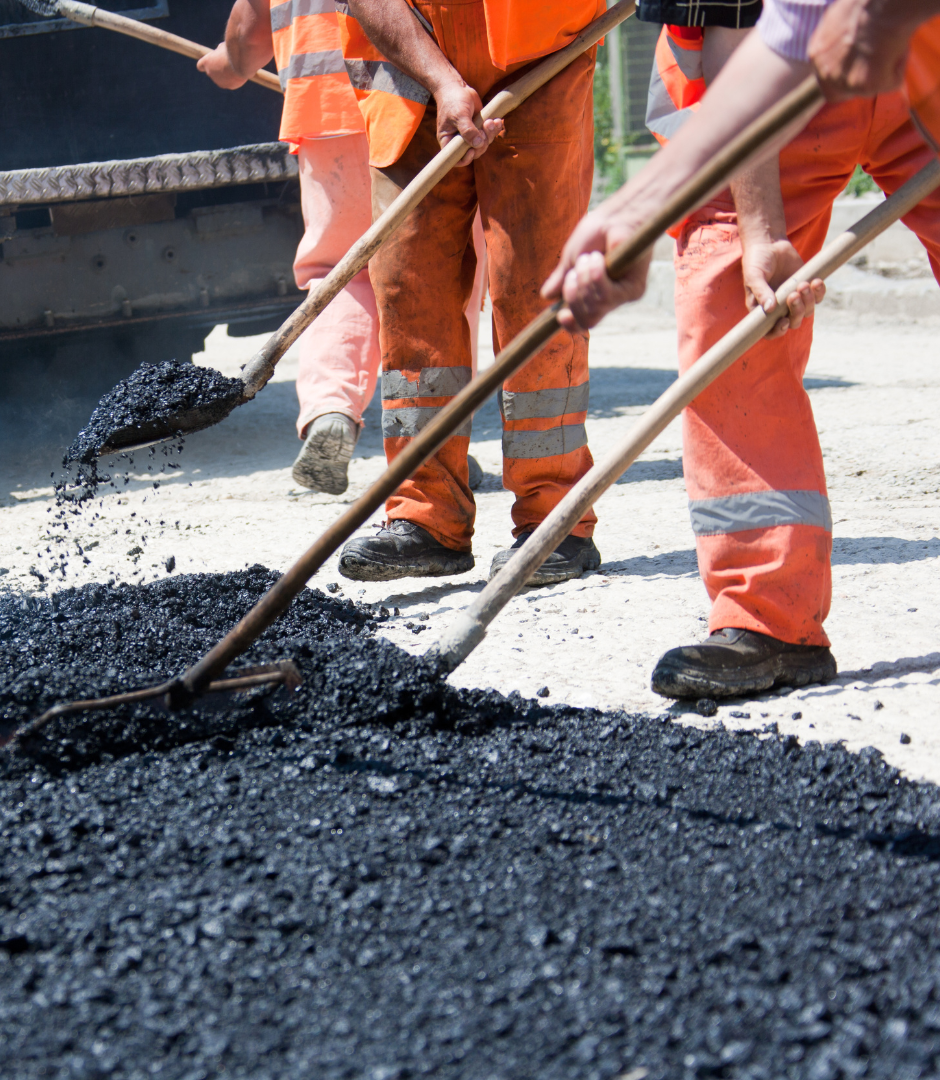
7. Place hot mix in workable lifts
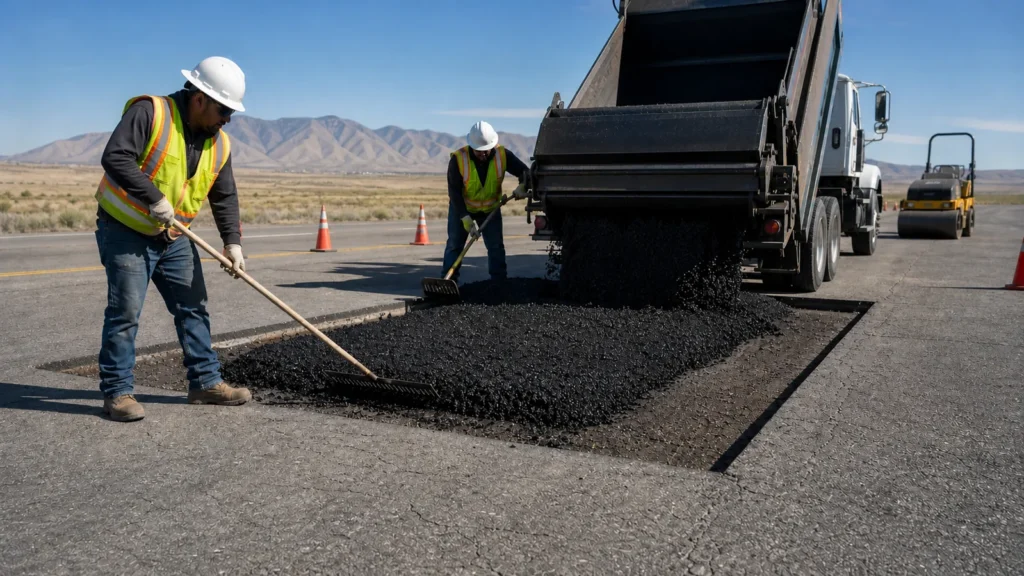
Coordinate trucking so the mix can be placed and compacted before it cools. Lift depth should suit the mix, repair geometry, and compaction equipment. Dumping a deep mass into a hole and rolling only the top can leave poorly compacted material below. Handwork should avoid segregation and feathered edges.
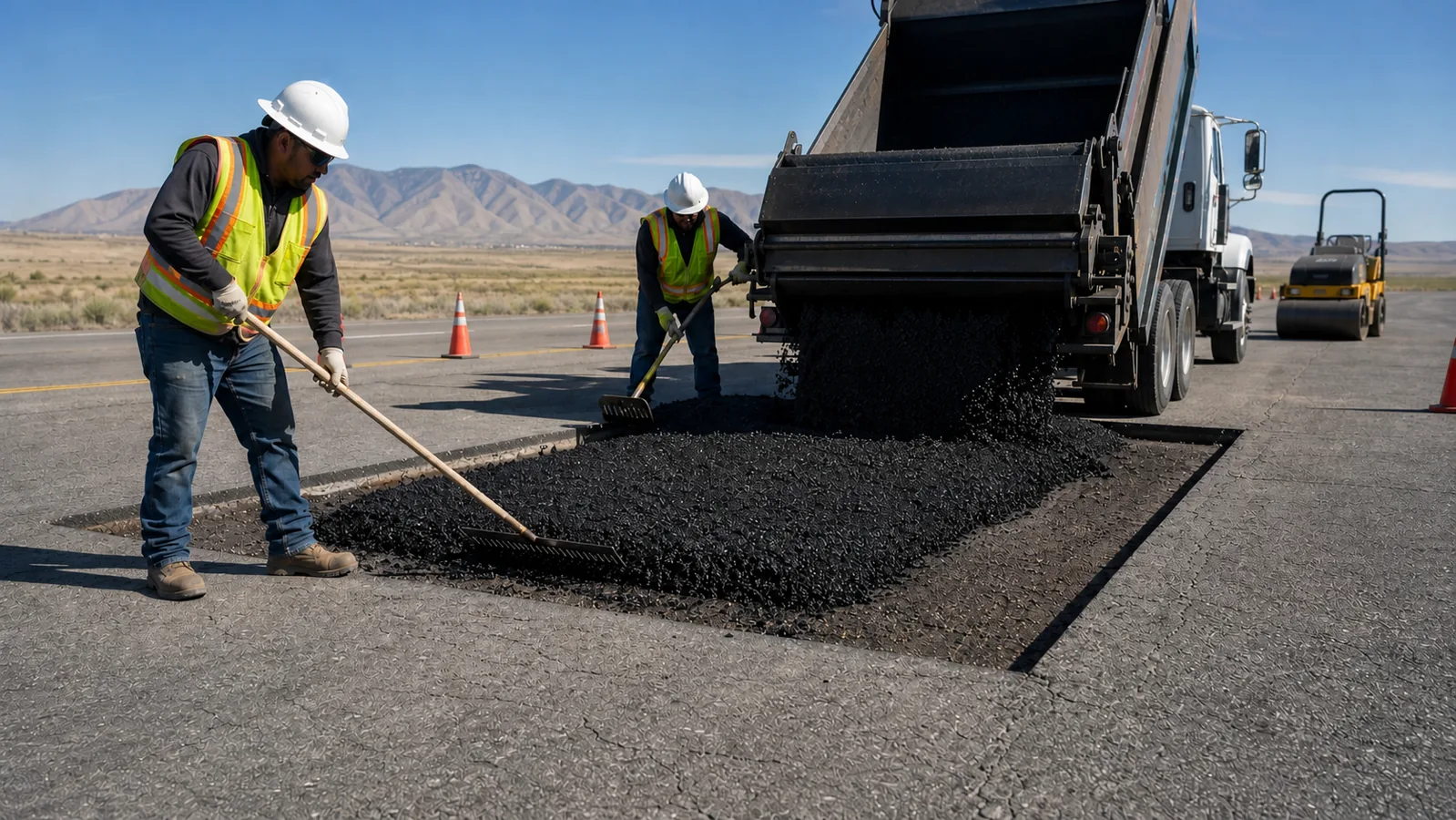
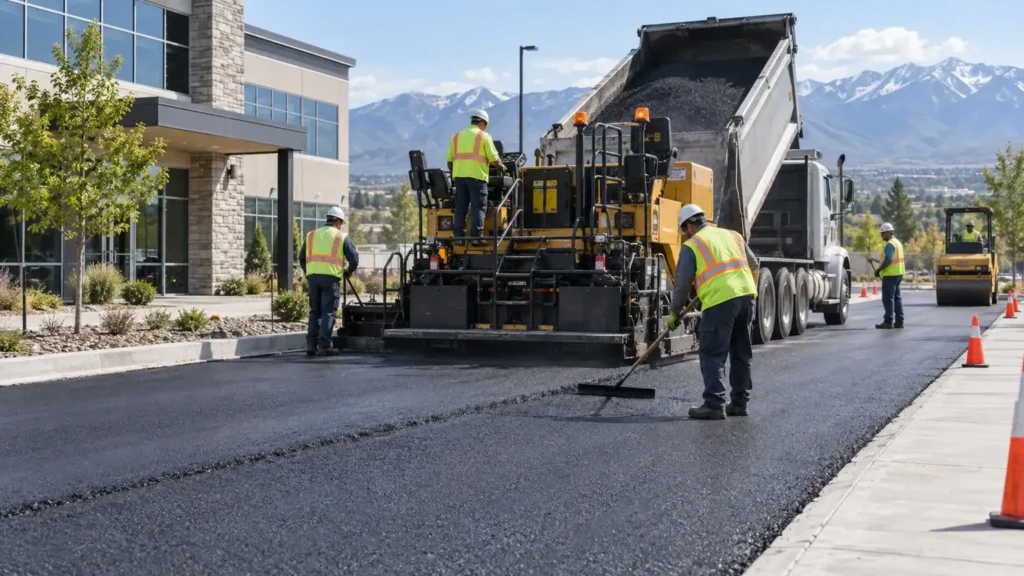
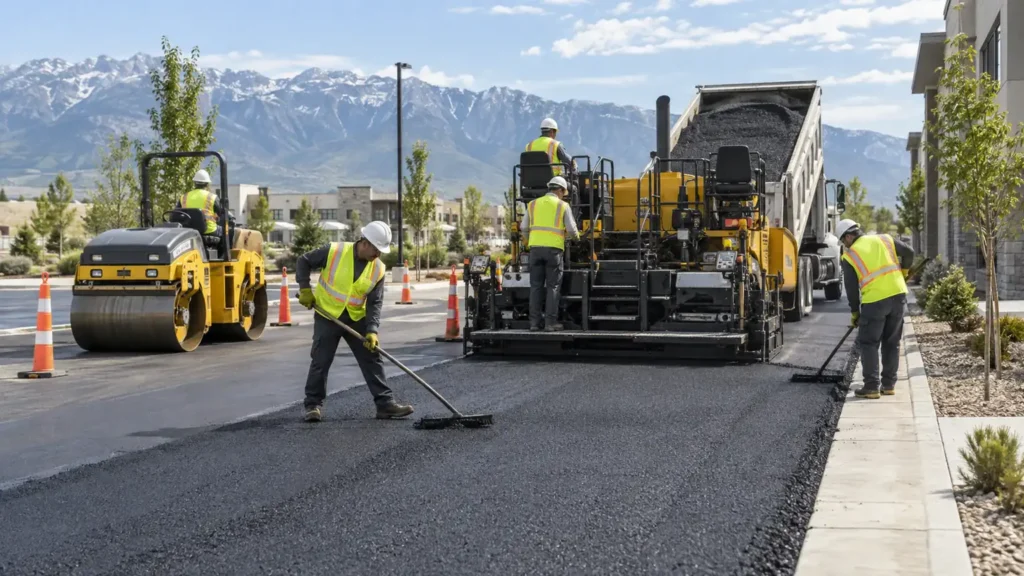
Original AI-assisted illustration of a representative full-depth hot-mix repair. It is not a photograph of an 801 Asphalt project.
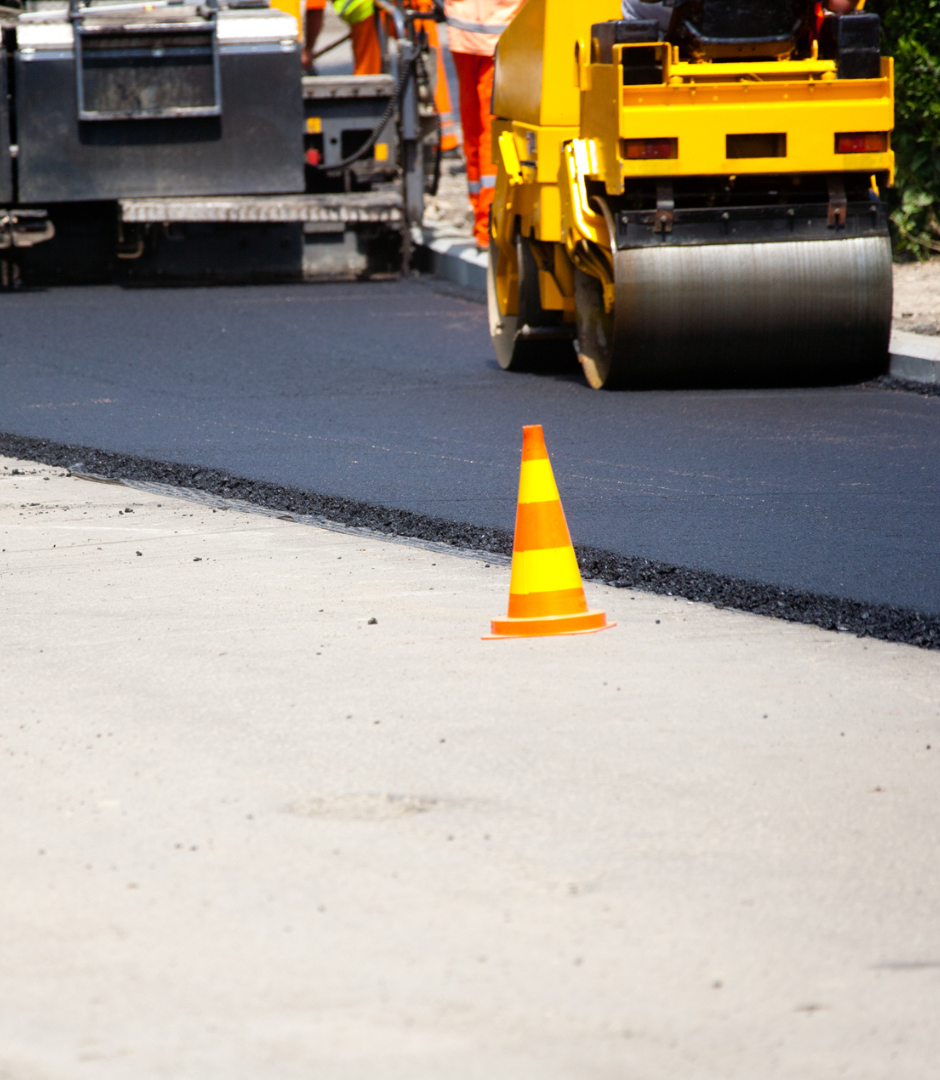
8. Compact joints, center, and transitions
Use a planned rolling sequence while the material remains workable. Pay attention to perimeter density and to the transition between new and existing pavement. The patch should not create a trip edge, open seam, abrupt bump, or low point that holds water. Verify compacted thickness and acceptance requirements defined by the contract.
9. Inspect, protect, and document reopening
Review smoothness, grade, drainage, edges, joints, cleanliness, and any restored markings. Reopening guidance should reflect mix, temperature, patch depth, and vehicle type. Passenger cars and heavy construction vehicles may not have the same restriction. Record completed quantities, approved scope changes, materials, weather, and defects outside the repaired area.
2026 asphalt repair costs in Eagle Mountain
The following Utah contractor-published examples were checked August 25, 2026. They are planning references—not government schedules, independent market averages, guaranteed rates, or quotes from 801 Asphalt.
| Repair scope | Published Utah planning range | Unit | Main cost drivers | Source |
|---|---|---|---|---|
| Small surface pothole | About $100–$400 | each | Minimum mobilization, cleaning, material, access | 801 Asphalt repair cost guide |
| Pothole with base repair example | About $400–$800 | each | Saw cuts, depth, failed base, hot mix, compaction | 801 Asphalt paving cost guide |
| Crack work | About $1–$3 | linear foot | Cleaning, width, routing, sealant, quantity | 801 Asphalt repair cost guide |
| Depressed-area patch | About $3–$7 | square foot | Leveling, base correction, drainage, geometry | 801 Asphalt repair cost guide |
| Full-depth failed-area repair | About $6–$12 | square foot | Removal, trench or base work, asphalt depth, disposal | 801 Asphalt repair cost guide |
| Patch or overlay example | About $3–$5 | square foot of repaired area | Area, preparation, thickness, equipment access | 801 Asphalt paving cost guide |
Small repairs can have a high unit cost because the crew, truck, compactor, traffic controls, and hot mix still require mobilization. Long access, active construction, multiple closure phases, utility coordination, dust control, and hidden trench failure can add time. Bundling several appropriate repairs may reduce repeated mobilization, but different failure types should not be forced into one method for convenience.
Three practical Eagle Mountain repair questions
When is a surface patch enough, and when must failed base be removed?
A surface repair may be reasonable when deterioration is shallow and the pavement around it remains stable. Full-depth work is more likely when the surface moves, the same defect returns, alligator cracks connect across an area, a trench has settled, or excavation reveals weak support. The decision should follow field evidence and intended traffic, not only the color or width of the crack.
Why do potholes or alligator cracks return after a cosmetic repair?
Common causes include water, loose edges, inadequate bonding, insufficient compaction, a weak base, construction loading, or a settlement zone wider than the visible hole. If the cause remains, traffic flexes the patch and cracks the boundary. Repeated failure is a reason to investigate depth and drainage before paying for another surface fill.
How should a property manager prioritize repairs before Utah winter?
Address immediate hazards and open defects that admit significant water first. Then prioritize entrances, accessible routes, school or customer paths, truck lanes, and failures beside drainage channels. Document lower-priority cosmetic defects for the next maintenance cycle. Suitable weather and hot-mix availability still matter; a clearly identified temporary repair can be more responsible than promising permanent performance in unsuitable conditions.
Quality checklist for an Eagle Mountain repair proposal
Use this checklist when comparing commercial pavement repair involving Asphalt in Utah:
- Are defects mapped by type, quantity, and priority?
- Does the scope distinguish pothole repair, crack work, surface patching, and full-depth asphalt patching?
- Are assumed depth, compacted asphalt thickness, and base quantity written?
- Is utility-trench history or pavement base failure addressed?
- Are water, drainage, ponding, edges, and grade considered?
- Are saw cuts, sound faces, bonding treatment, lifts, and compaction described?
- Does the proposal identify temporary cold mix versus permanent hot mix?
- Are utility locating, private utilities, access, phasing, and construction traffic assigned?
- Are dust control, weather, haul distance, and hot-mix availability acknowledged?
- Are disposal, restored striping, drains, lids, and concrete transitions included or excluded?
- Is the hidden-condition change process clear?
- Can the contractor explain why repair is preferable to overlay or replacement for each area?
Repair the support, then restore the surface
Start with a defect map and the site's history. Note recurring depressions, utility crossings, heavy construction routes, water, broken edges, and earlier patches. Ask bidders to use the same repair limits, compacted section, base assumptions, and traffic-control plan. That reveals whether a lower total reflects efficiency or simply less work.
Learn about 801 Asphalt's asphalt repair service, browse the Eagle Mountain article hub, and read the related guides for new asphalt paving in Eagle Mountain and full-depth repair decisions in Draper.
Request a free project assessment or call (801) 277-4258. Ask for a measured, scope-matched written quote and compare repair depth, base work, drainage, traffic control, and exclusions—not just total price.
Editorial disclosure
Author: 801 Asphalt Editorial Team
Technical review: Automated source, pricing, link, and claims validation completed August 25, 2026; no unverified local project claim was included.
Published and updated: August 25, 2026
AI assistance: AI assisted with drafting and the two original illustrations. The images are representative scenes, not photographs of 801 Asphalt projects.
Sources and review notes
- Eagle Mountain City Streets Department
- Eagle Mountain City Construction and Design Standards
- Eagle Mountain City engineering and mapping resources
- 801 Asphalt repair cost guide
- 801 Asphalt paving cost guide
- 801 Asphalt repair service
Sources and prices checked August 25, 2026. Contractor-published figures are market examples, not government schedules, independent averages, an 801 Asphalt price list, or guaranteed quotes. No unverified project-history, ranking, licensing, warranty, lowest-price, or local-experience claim is included.