For residential asphalt paving alpine utah, the useful first answer is not a universal price or a cosmetic promise. Residential asphalt paving turns a driveway, private approach, parking pad, or small private lane into a complete drainage-and-support system. The visible mat performs only when grades, base, edges, transitions, and opening limits are designed together. Alpine is a foothill community with residential driveways, schools, churches, neighborhood facilities, steep approaches, snowmelt, irrigation, and site-specific soil or geotechnical conditions. Drainage toward Utah Lake and protected hillside settings make grade and material containment especially important.
Current Utah planning ranges place this work around $4–$8 per sq. ft. for many new Utah residential paving scopes; $5–$10 per sq. ft. for many tear-out and repave projects; steep grades, long approaches, restricted access, drainage, and base correction can increase the written quote. Those figures are not government schedules, guaranteed prices, or an 801 Asphalt rate card. A site visit can change the scope because quantity, existing condition, drainage, access, mobilization, materials, traffic control, weather, and required testing all affect cost.
801 Asphalt provides a detailed, scope-matched quote and aims to stay competitive for comparable Utah work. Invite each bidder to price the same map, quantities, assumptions, preparation, materials, quality checks, and exclusions; then ask for a written comparison when another proposal appears lower.
801 Asphalt is licensed and insured, brings over 30 years of experience, provides asphalt and concrete services, and uses the owner-confirmed slogan “Utah’s #1 Asphalt Company for the Smart Buyer.” The company offers competitive pricing and a 10-year workmanship warranty. The written project proposal controls the warranty’s exact scope, terms, exclusions, notice requirements, and remedies.
Quick navigation
- Who this service fits
- Alpine planning conditions
- Method selection
- High-quality procedure
- 2026 Utah budgeting ranges
- Niche questions
- Quote checklist
Property fit and unsuitable cases
Professional residential asphalt paving is commonly a good planning fit for:
- homeowners replacing gravel or failed asphalt driveways.
- rural and suburban properties with long private approaches.
- small multifamily owners improving resident parking and access.
- HOAs paving private lanes with a documented traffic plan.
- owners coordinating a driveway with garage, walk, curb, irrigation, and drainage work.
Residential paving should wait when property boundaries, right-of-way authority, drainage outlets, utility plans, retaining conditions, or soft and saturated support remain unresolved. A thin surface placed over those uncertainties can transfer them directly into the new pavement.
A high-quality recommendation may divide one property into several treatments. That is often more honest than forcing every square foot into a single scope. The estimator should explain what is being preserved, what is being repaired, what needs a capital solution, and what should simply be monitored.
Alpine conditions that change the scope
Alpine is a foothill community with residential driveways, schools, churches, neighborhood facilities, steep approaches, snowmelt, irrigation, and site-specific soil or geotechnical conditions. Drainage toward Utah Lake and protected hillside settings make grade and material containment especially important.
For residential asphalt paving, the local angle in this batch is foothill grades, site-specific geotechnical conditions, residential driveways, schools and churches, snowmelt, irrigation, protected viewsheds, and drainage toward Utah Lake. That combination calls for a written site map rather than a city-name assumption. Two properties in Alpine can have different soils, drainage, traffic, utility history, shade, operations, and approved plans; the article therefore does not claim a universal municipal specification or prior 801 Asphalt project experience.
An Alpine scope should trace water from uphill landscaping and roofs through every paved low point, measure steep transitions, protect resident and pedestrian access, and identify equipment staging that does not block public roads. Weather and shade can produce different preparation windows on one property.
Alpine Engineering and Public Works publish construction standards, storm-drain guidance, erosion-control information, and traffic-control requirements for applicable work. Owners should confirm current permits and approved plans whenever work affects public streets, drainage, or regulated development.
Inspect both the paved surface and the slope relationships outside the work limit. Weak fill, seepage, unsupported edges, or a retaining condition may control the repair. A proposal should identify grade-control points and a stop-work process if unexpected soil, moisture, or movement appears.
An Alpine paving decision should begin above the visible pavement. Trace roof water, irrigation, snowmelt, hillside runoff, and landscape drainage to each low point and final outlet. Measure steep driveway transitions at the street, garage, walk, and accessible route; visual judgment alone can miss clearance or ponding problems. Mark retaining conditions, fill slopes, unsupported edges, and any area where seepage or soil movement is suspected. The proposal should name the evidence that triggers geotechnical review or a stop-work decision, along with unit prices for approved corrective work. Traffic-control and staging plans must keep equipment and materials out of public roads unless current authorization exists. These controls connect the pavement section to Alpine’s grade, drainage, and site-support realities rather than treating the project as flat-valley paving.
Before work, the owner should identify jurisdiction, property boundaries, public right-of-way, utility ownership, approved drainage, accessible routes, fire access, and any planned construction. Routine private maintenance and regulated public or development work are not interchangeable. When permits, engineered design, or approved-plan changes may apply, confirm them with the city and the appropriate licensed professional.
Choose the treatment from evidence
Start at the garage, building threshold, or uphill limit and trace water to an approved outlet. A driveway can look smooth yet create a pond, scrape a vehicle, bury curb reveal, or send runoff across a walk when control elevations are not measured before excavation.
Daily passenger vehicles may be the normal load, but moving trucks, trailers, recreational vehicles, service equipment, snowplows, and waste vehicles can govern isolated zones. The proposal should state which users the section and edges are intended to support.
Residential access constrains production. Narrow gates, steep slopes, overhead lines, landscaping, walls, shared drives, and a single garage entrance can change equipment, trucking, handwork, compaction, and phase decisions. Those conditions belong in the scope, not in an unpriced assumption.
The decision record should be visible in the proposal. A low total can reflect a genuinely efficient scope, but it can also reflect less preparation, smaller quantities, thinner sections, omitted traffic control, or a treatment that does not address the failure. Price comparison becomes meaningful only after those differences are normalized.
The terminology that appears naturally in a thorough scope includes residential asphalt paving, asphalt driveway, private lane paving, hot mix asphalt, aggregate base, driveway drainage, asphalt compaction, residential paving cost, driveway edge support, Utah paving contractor, freeze-thaw pavement, snow removal surface, Asphalt in Utah. These phrases describe decisions and work elements; repeating them without useful explanation would not improve the project or the article.
High-quality procedure
1. Assess and document the site
Map pavement limits, traffic, soils or existing distress, utilities, drainage, grades, access, and structures. Use cores, test pits, proof rolling, survey, or engineering evaluation when visual inspection cannot establish support or elevation requirements.
2. Define the section and quantities
State excavation, aggregate type and compacted depth, asphalt mixture, lift count, compacted thickness, edge support, tack, joints, and testing. Separate known quantities from unit-price contingencies for unsuitable material or added drainage work.
3. Plan traffic and environmental controls
Create phases for vehicles, pedestrians, deliveries, waste service, emergency access, and approved accessible routes. Protect inlets and prevent sediment, millings, fuel, tack, and cleanup water from leaving the controlled area.
4. Excavate and prepare subgrade
Remove unsuitable material to the approved limits, shape the subgrade, and address wet or pumping areas. Do not bridge visible movement with aggregate and hope compaction will solve an unidentified water or soil problem.
5. Place and compact aggregate base
Install suitable road base in controlled lifts, adjust moisture where necessary, and compact with equipment appropriate to the site. Verify depth, firmness, grade, and edge confinement before paving covers the work.
6. Place hot mix within the workable window
Coordinate plant, trucks, paver, rollers, weather, and access so hot mix asphalt arrives and is placed at suitable temperatures. Maintain continuous paving where practical and construct planned joints when continuity is impossible.
7. Compact and finish the mat
Use a rolling pattern matched to mix, lift, temperature, and geometry. Check density or specified acceptance measures, surface texture, joints, smoothness, transitions, and drainage before equipment leaves the phase.
8. Protect, inspect, and reopen
Barricade the area until it can carry intended traffic. Document weather, tickets or material records, measurements, compaction or testing required by contract, drainage observations, punch-list corrections, and maintenance guidance.
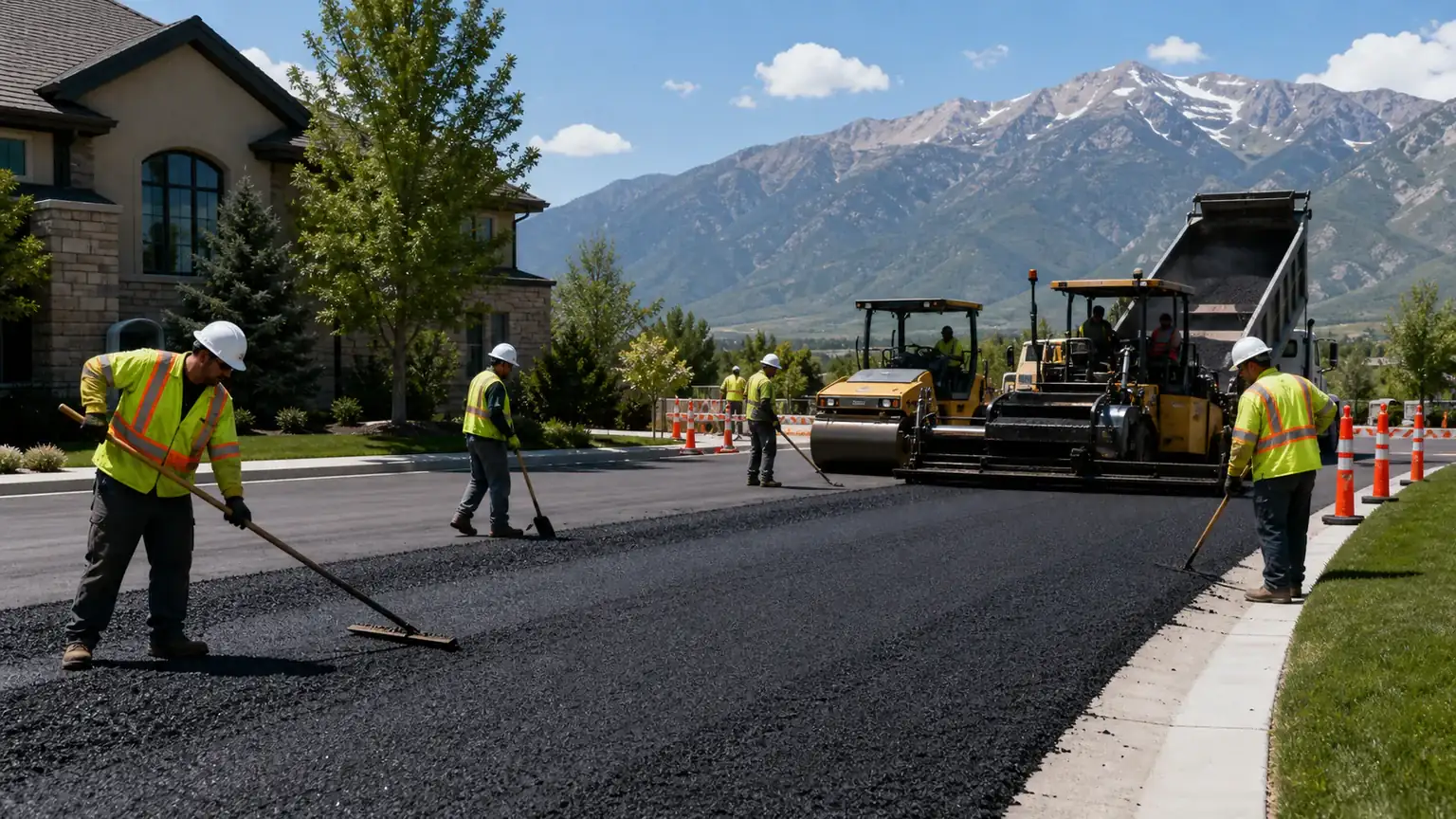
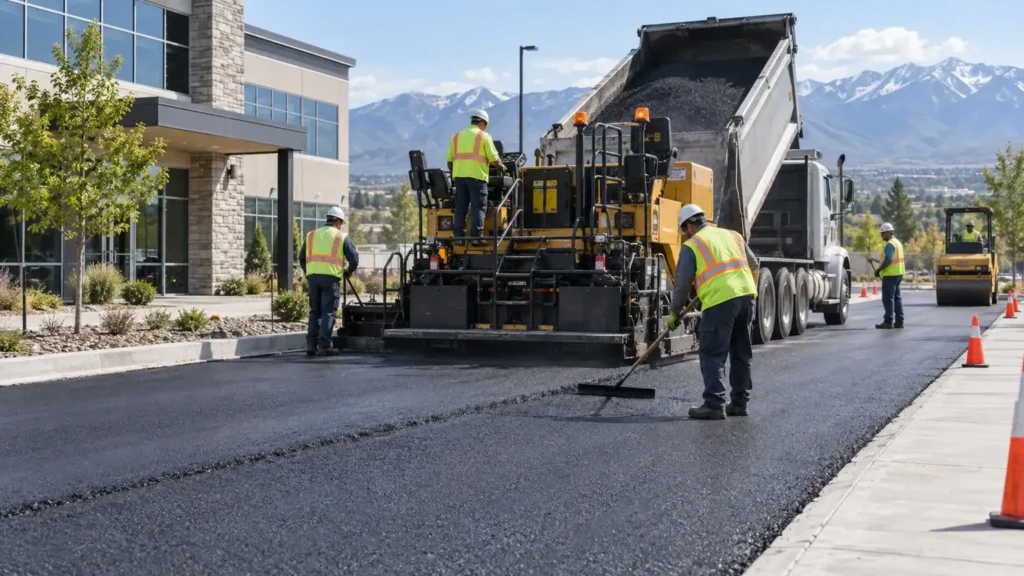
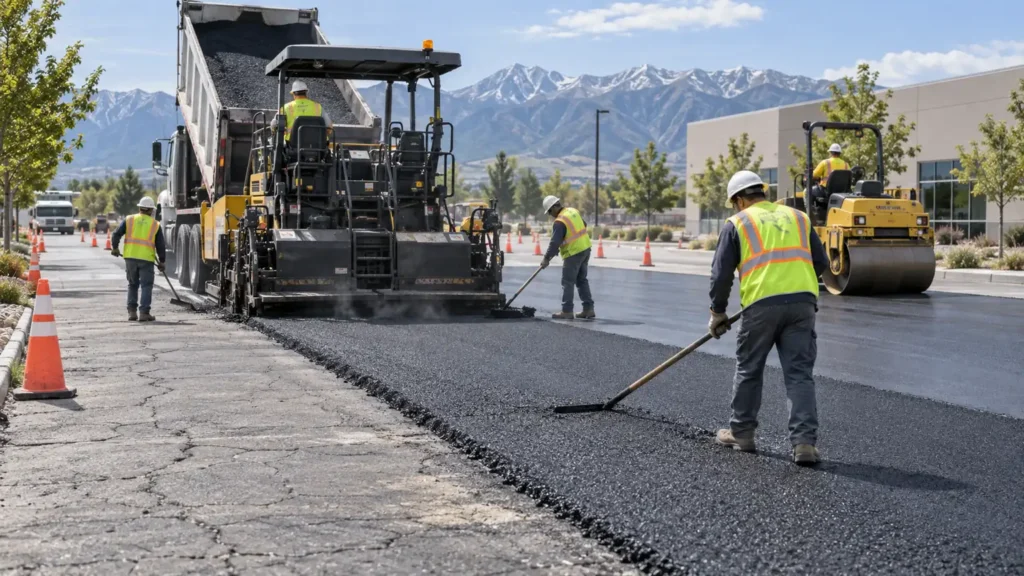
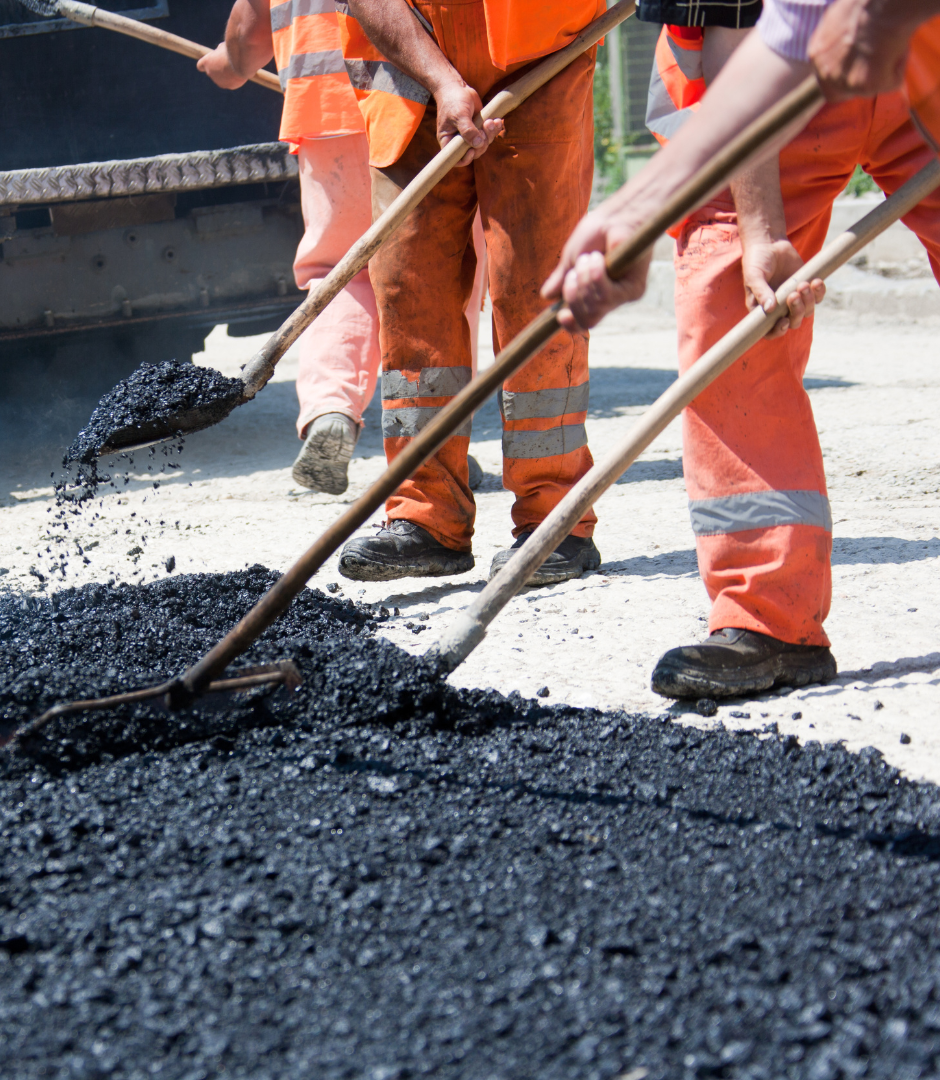
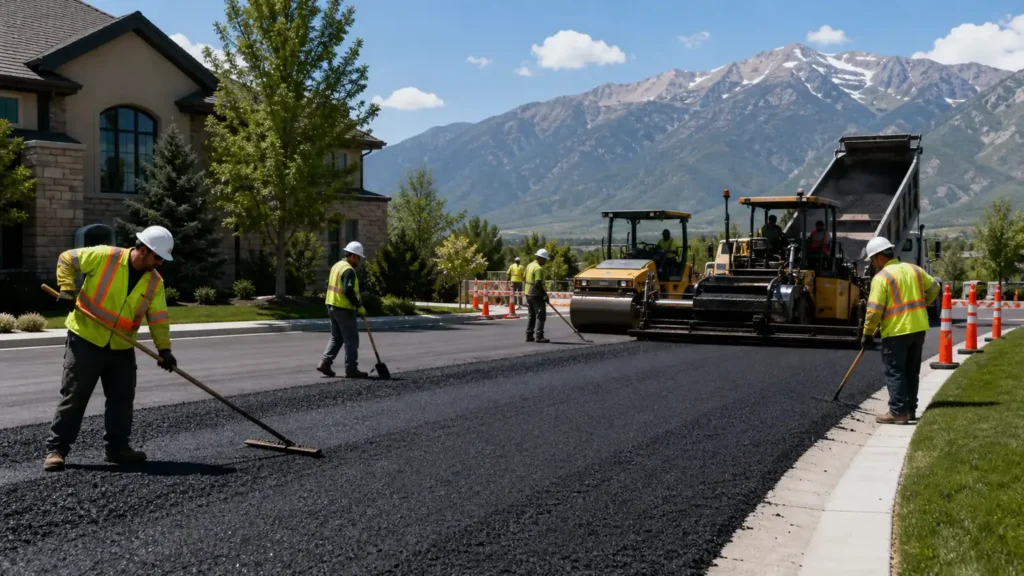
Original AI-assisted illustration of representative residential asphalt paving work in Alpine, Utah; not a photograph of an 801 Asphalt project.
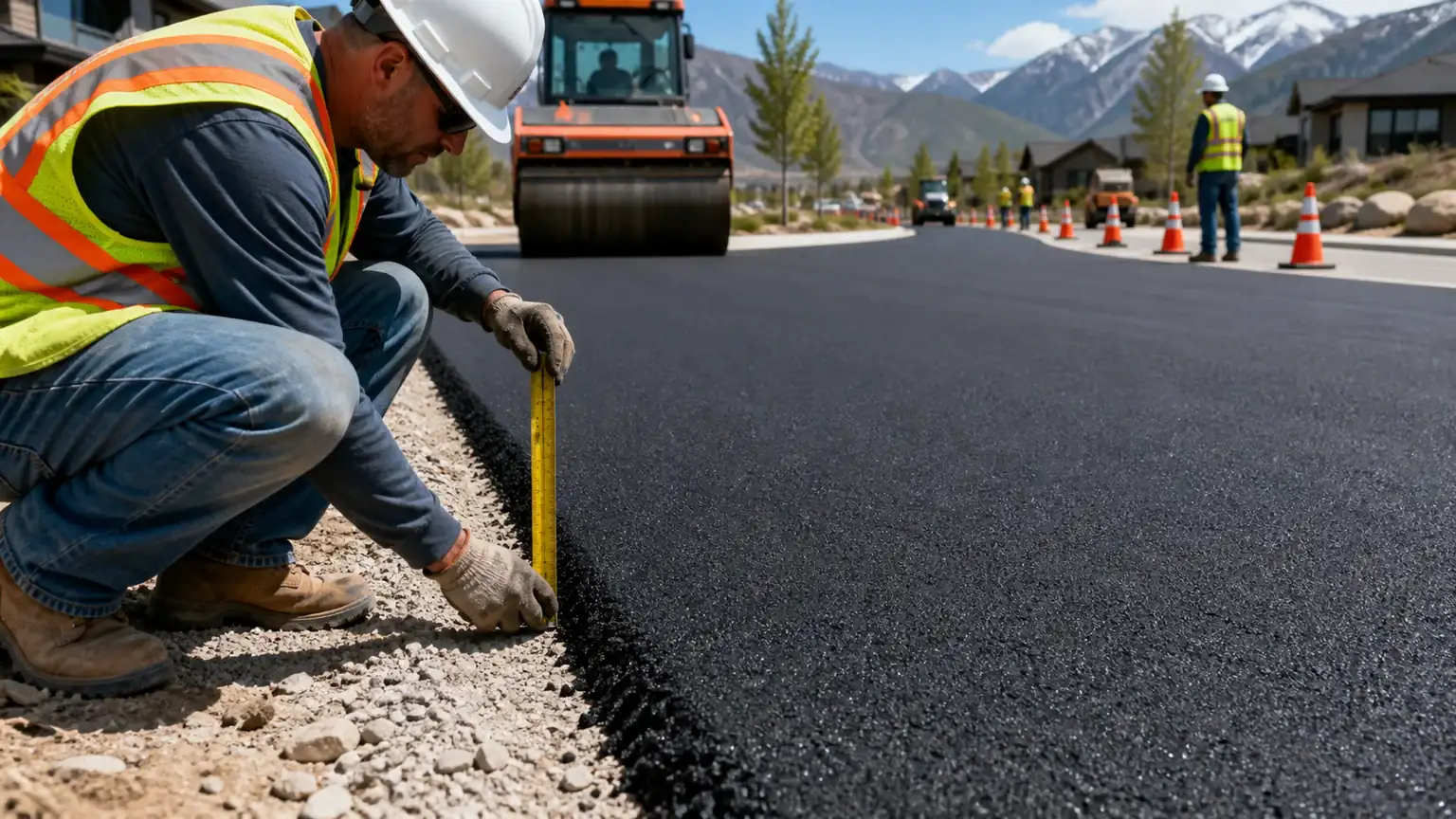
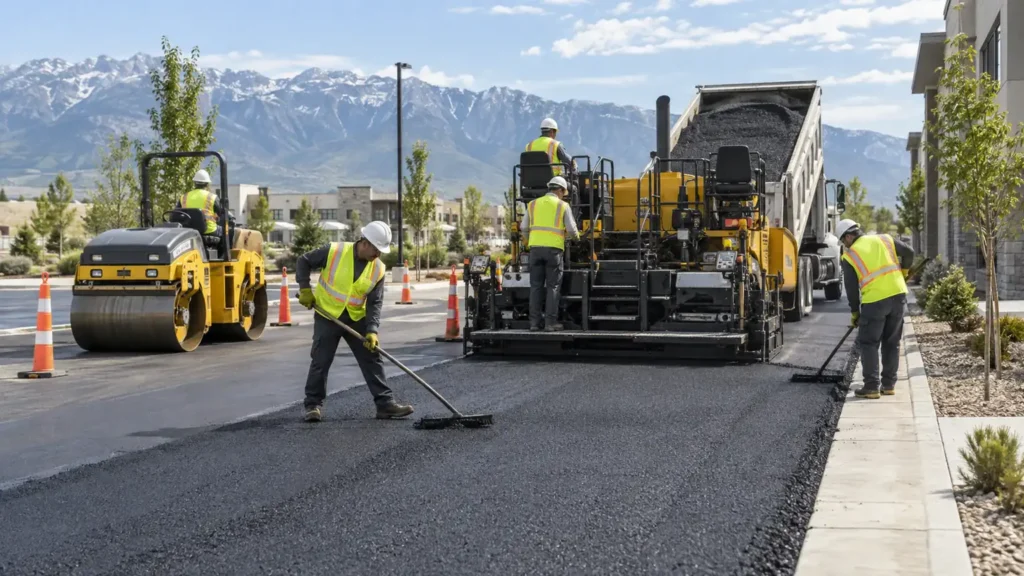
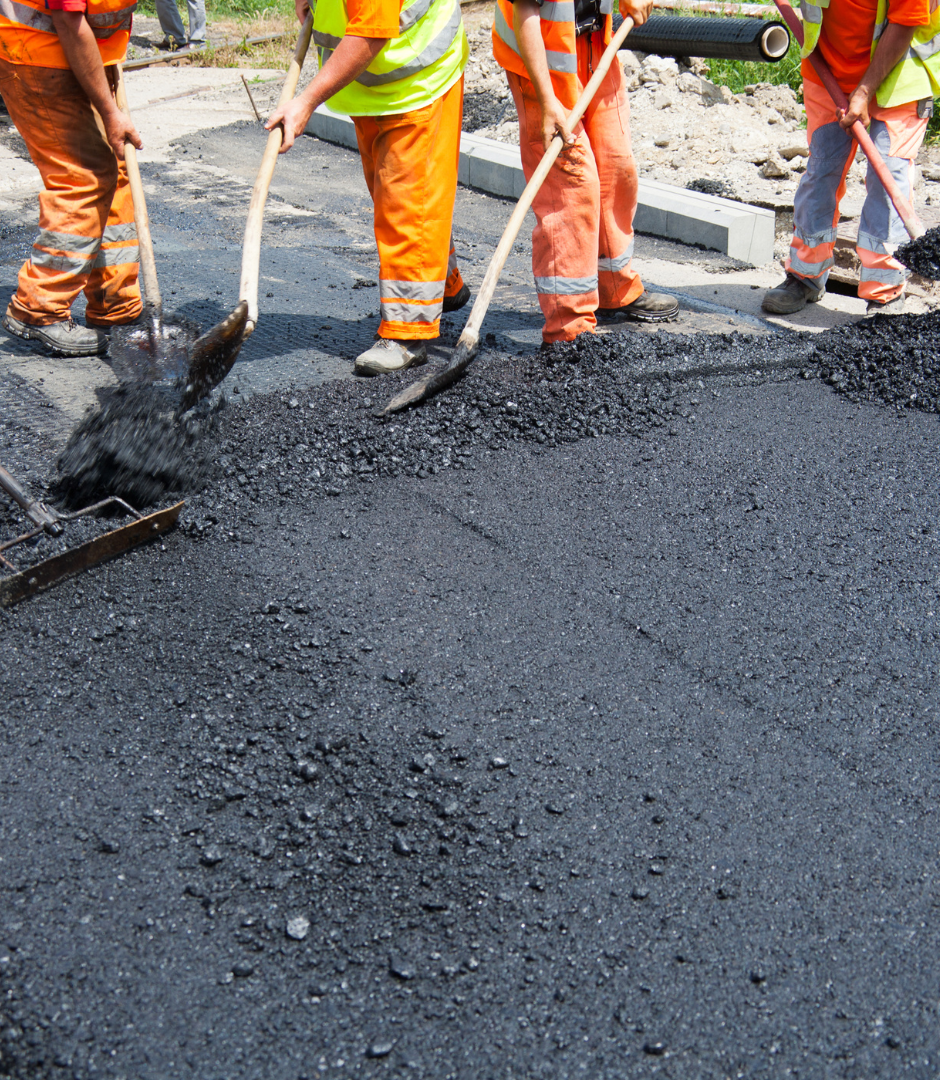
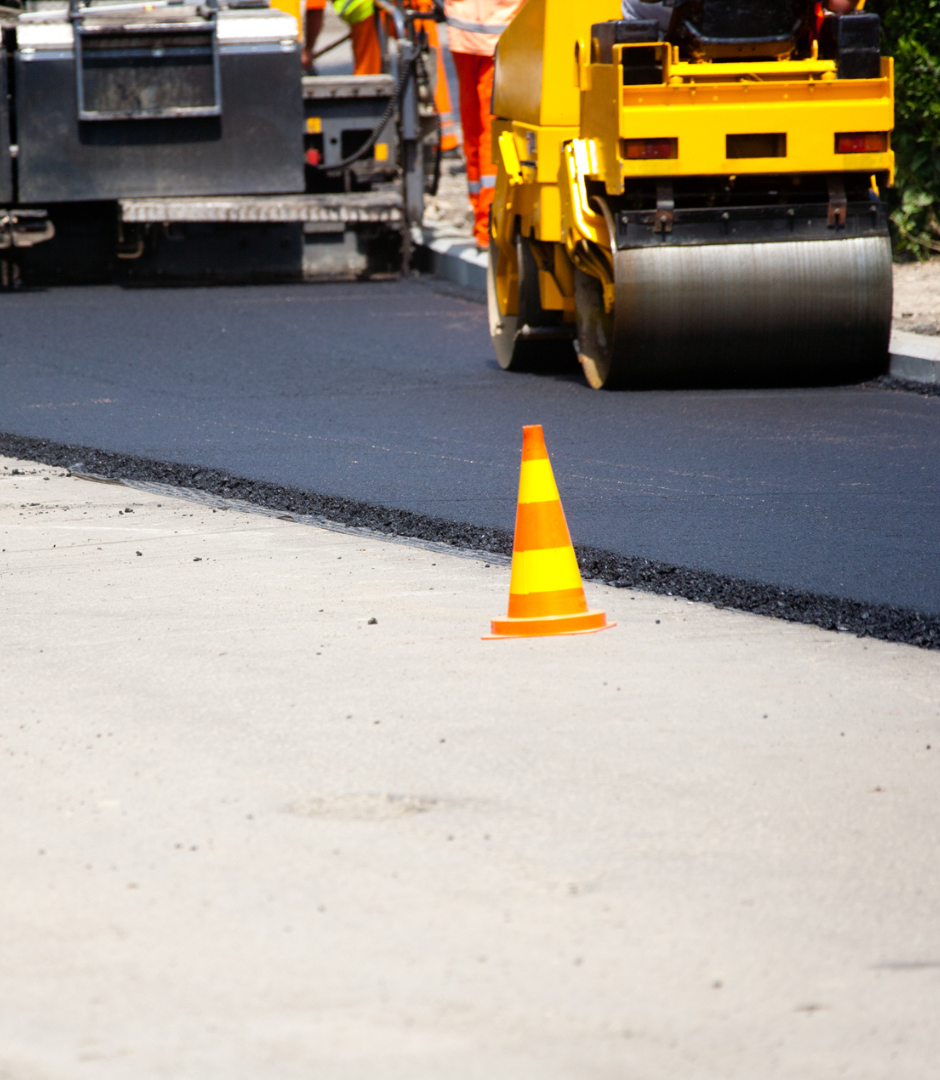
Original AI-assisted illustration of a representative residential asphalt paving quality-control step in Alpine, Utah; not a photograph of an 801 Asphalt project.
2026 residential asphalt paving budgeting in Alpine
The following current Utah planning examples were checked September 1, 2026. They are starting points for budgeting-not quotes, a promise that every project falls inside the range, or evidence that one contractor is the cheapest.
| Scope | Published planning range | Unit | Major cost drivers | Source |
|---|---|---|---|---|
| New residential asphalt paving | $4–$8 | square foot | Size, access, preparation, traffic control, material and existing condition | Current Utah planning source |
| Tear-out and repave | $5–$10 | square foot | Size, access, preparation, traffic control, material and existing condition | Current Utah planning source |
| Suitable overlay alternative | $2.50–$4.50 | square foot | Size, access, preparation, traffic control, material and existing condition | Current Utah planning source |
| Base or drainage correction | site-specific | measured allowance | Size, access, preparation, traffic control, material and existing condition | Current Utah planning source |
Small projects can carry a higher unit cost because crew, equipment, trucking, traffic control, and setup are spread across fewer units. Large or repeatable phases may gain efficiency, while tight access, night work, deep repair, drainage correction, specialty materials, public interfaces, testing, and several mobilizations can raise the total.
Ask for measured quantities and alternates. A useful proposal can show a base scope, priority repairs, optional phases, unit prices for uncertain conditions, and work that should be deferred. That structure makes an 801 Asphalt quote easier to compare with another Utah proposal without claiming a guaranteed lowest price.
Three Alpine questions
What should a residential paving quote state?
It should state measured area, excavation, aggregate base, asphalt mixture, compacted thickness, transitions, edges, drainage, traffic control, testing or documentation, exclusions, and unit prices for authorized unforeseen support correction.
How are steep Utah driveways handled?
Measure grades and vertical curves, check vehicle clearance, control downhill movement of material and equipment, protect runoff paths, and choose placement and compaction methods that can safely achieve the written section.
When should paving be postponed?
Postpone when the base is pumping or frozen, drainage or utility work is unresolved, access cannot support the crew safely, or weather and supply conditions cannot maintain workable hot-mix placement and compaction.
Scope-matched quote checklist
Use this checklist when comparing residential asphalt paving proposals for Asphalt in Utah:
- Are the work limits and quantities mapped rather than described only as “all needed areas”?
- Does the proposal identify suitable and unsuitable conditions for the treatment?
- Are preparation, materials, application or placement rates, thicknesses, and quality checks stated?
- Are drainage, utilities, irrigation, structures, edges, and existing failures addressed?
- Are pedestrian, accessible-route, delivery, resident, customer, and emergency needs planned?
- Are weather limits, cure or cooling requirements, barriers, and reopening authority clear?
- Are mobilization, traffic control, testing, disposal, taxes, and specialty work included or excluded?
- Are unit prices and change-order triggers provided for uncertain conditions?
- Will the contractor document materials, quantities, weather, photographs, and completed areas?
- Do competing bids use the same map, assumptions, and acceptance criteria?
Turn the site walk into a comparable plan
Walk the property with a numbered map and photograph drainage, structures, utilities, traffic paths, edges, and each proposed work area. Ask every bidder to identify suitable and unsuitable treatment areas and to state measurable preparation, materials, quality controls, cure or reopening rules, and exclusions. Written equivalence is what makes a price comparison fair.
Learn about 801 Asphalt's residential asphalt paving service, browse the Alpine asphalt article hub, and read the related Alpine asphalt repair guide and Alpine sealcoating planning guide.
Request a free project assessment or call (801) 277-4258. Ask for a scope-matched written quote that separates quantities, preparation, materials, traffic control, quality checks, and exclusions.
Editorial disclosure
Author: 801 Asphalt Editorial Team
Technical review: Automated source, pricing, link, image, claims, and duplication validation completed 2026-09-01. Licensing, insurance, experience, concrete capability, slogan, competitive-pricing, and workmanship-warranty statements are owner-confirmed first-party business claims; no unverified local project-history or city-experience claim was included.
Published and updated: 2026-09-01
AI assistance: AI assisted with drafting and the two original illustrations. The images are representative scenes, not photographs of 801 Asphalt projects.
Sources and review notes
- https://www.alpineut.gov/163/Engineering-Public-Works
- https://www.alpineut.gov/DocumentCenter/View/622/Alpine-City-Standard-Specifications-and-Drawings-2023
- https://801-asphalt.com/guides/utah-asphalt-paving-cost/
- https://www.udot.utah.gov/connect/business/design/standards/
Sources and prices checked September 1, 2026. Planning figures are budgeting references, not government schedules, an 801 Asphalt price list, or guaranteed quotes. Applicable public or permitted work should be checked against current Alpine requirements and approved plans.