For pavement maintenance sandy utah, the useful first answer is not a universal price or a cosmetic promise. A maintenance plan converts inspections into timed repairs, crack treatment, surface preservation, markings, drainage care, and capital forecasting. The goal is to use the least invasive suitable treatment before structural failure removes that option. Sandy combines east-bench grades with established commercial corridors, schools, HOAs, offices, retail centers, and older utility networks. Elevation changes can concentrate snowmelt at lower entrances and parking rows, while mature landscaping and irrigation can keep isolated edges wet after the rest of a site appears dry.
Current Utah contractor-published planning examples place this work around component planning examples include about $0.20–$0.50 per sq. ft. for sealcoating, $1–$3 per linear foot for crack sealing, and published Utah striping units around $15–$25 per standard stall; repairs, mobilization, access, and phased work are separate. Those figures are not government schedules, independent averages, guaranteed prices, or an 801 Asphalt rate card. A site visit can change the scope because quantity, existing condition, drainage, access, mobilization, materials, traffic control, weather, and required testing all affect cost.
801 Asphalt provides a detailed, scope-matched quote and aims to stay competitive for comparable Utah work. Invite each bidder to price the same map, quantities, assumptions, preparation, materials, quality checks, and exclusions; then ask for a written comparison when another proposal appears lower.
Quick navigation
- Who this service fits
- Sandy planning conditions
- Method selection
- High-quality procedure
- 2026 Utah budgeting ranges
- Niche questions
- Quote checklist
Property fit and unsuitable cases
Professional pavement maintenance is commonly a good planning fit for:
- commercial owners managing several pavement zones or sites.
- HOAs and multifamily communities budgeting across years.
- schools, churches, and institutions coordinating seasonal closures.
- industrial properties separating heavy routes from passenger areas.
- homeowners wanting condition-based care instead of cosmetic schedules.
Preventive maintenance cannot rescue a failed structure. Pavement with widespread fatigue cracking, deep rutting, unstable support, major settlement, or unresolved drainage needs rehabilitation or reconstruction planning. A calendar-only sealcoat cycle can waste money when condition is ignored.
A high-quality recommendation may divide one property into several treatments. That is often more honest than forcing every square foot into a single scope. The estimator should explain what is being preserved, what is being repaired, what needs a capital solution, and what should simply be monitored.
Sandy conditions that change the scope
Sandy combines east-bench grades with established commercial corridors, schools, HOAs, offices, retail centers, and older utility networks. Elevation changes can concentrate snowmelt at lower entrances and parking rows, while mature landscaping and irrigation can keep isolated edges wet after the rest of a site appears dry.
For pavement maintenance, the local angle in this batch is east-bench grades, snowmelt routes, established utilities, schools, HOAs, retail centers, and constrained entrances. That combination calls for a written site map rather than a city-name assumption. Two properties in Sandy can have different soils, drainage, traffic, utility history, shade, operations, and approved plans; the article therefore does not claim a universal municipal specification or prior 801 Asphalt project experience.
A useful Sandy work plan maps uphill inflow, low points, plow routes, utility cuts, garage or loading transitions, and the route people use between parking and entrances. Phasing matters because compact access points may need to remain available to residents, customers, waste vehicles, emergency responders, and deliveries.
When work touches public improvements, drainage, a sensitive area, or an approved development plan, the owner should confirm current Sandy Engineering requirements. Debris, slurry, aggregate, coating, fuel, and wash water should be contained instead of allowing gravity to carry them toward a downstream inlet.
A Sandy estimator should compare shaded east-bench zones with sun-exposed commercial pavement because thaw timing and surface dryness can differ on the same day. Sloped entrances deserve a vehicle-clearance check at transitions, and downhill work limits should be inspected for water entering from cracks or landscaping above them. On occupied HOA or medical properties, phase boundaries should coincide with workable alternate routes rather than arbitrary square-foot targets. Those observations can change repair limits, material timing, barrier placement, and the sequence in which the property returns to use.
Before work, the owner should identify jurisdiction, property boundaries, public right-of-way, utility ownership, approved drainage, accessible routes, fire access, and any planned construction. Routine private maintenance and regulated public or development work are not interchangeable. When permits, engineered design, or approved-plan changes may apply, confirm them with the city and the appropriate licensed professional.
Choose the treatment from evidence
Begin with a repeatable condition inventory. Divide pavement into zones and record cracking, oxidation, raveling, rutting, patches, drainage, edges, structures, markings, hazards, and traffic. Photographs and mapped quantities make deterioration visible from year to year.
Match treatment to condition. Crack sealing manages suitable openings; full-depth repair addresses localized structural failure; sealcoating protects stable weathered surfaces; striping restores an authorized layout; paving or reconstruction belongs in the capital plan when support or broad pavement fails.
Budget by risk and coordination. Safety, water entry, accessible and emergency routes, heavy loading, and failures likely to expand receive priority. Group compatible work—such as repair before crack treatment, coating, and striping—while respecting cure and operational windows.
The decision record should be visible in the proposal. A low total can reflect a genuinely efficient scope, but it can also reflect less preparation, smaller quantities, thinner sections, omitted traffic control, or a treatment that does not address the failure. Price comparison becomes meaningful only after those differences are normalized.
The terminology that appears naturally in a thorough scope includes pavement maintenance, parking lot maintenance plan, asphalt inspection, crack sealing, sealcoating, parking lot striping, pothole repair, preventive pavement maintenance, pavement condition survey, capital pavement planning, Utah asphalt maintenance, commercial property maintenance, Asphalt in Utah. These phrases describe decisions and work elements; repeating them without useful explanation would not improve the project or the article.
High-quality procedure
1. Create a pavement inventory
Map every paved zone, area, use, traffic class, drainage path, structure, edge, and marking system. Assign stable names so inspections, proposals, invoices, and photographs refer to the same locations.
2. Inspect condition consistently
Record crack type and quantity, patches, potholes, raveling, oxidation, rutting, settlement, ponding, edge loss, markings, hazards, and recent utility work. Inspect after runoff or snowmelt when water-related failures are hard to see in dry weather.
3. Classify treatment and urgency
Separate routine housekeeping, suitable crack sealing, localized repair, surface preservation, markings, drainage work, and capital rehabilitation. Prioritize hazards, active water entry, critical routes, and failures likely to grow.
4. Build a multi-year budget
Measure quantities and assign current planning ranges, mobilization, traffic control, testing, and contingency. Show near-term work, monitor-only zones, and future reconstruction so one cosmetic project does not consume structural funds.
5. Coordinate the treatment sequence
Complete drainage correction and structural repairs before crack sealing or coating; allow cure; coat only suitable pavement; stripe after the selected surface is ready. Plan phases around occupants and weather.
6. Control quality for each activity
Use service-specific preparation, materials, application or placement controls, traffic protection, and acceptance checks. A maintenance contract should not replace measurable procedures with a generic promise to “service the lot.”
7. Document closeout and exceptions
Record quantities, products, weather, mapped completion, photographs, tests required by contract, reopenings, excluded defects, and recommended monitoring. Retain the same map for the next inspection.
8. Review annually and after disruptive events
Update the plan after utility work, severe winter damage, drainage changes, tenant use changes, heavy construction traffic, or major repairs. Shift money when condition—not a fixed calendar—shows a different priority.
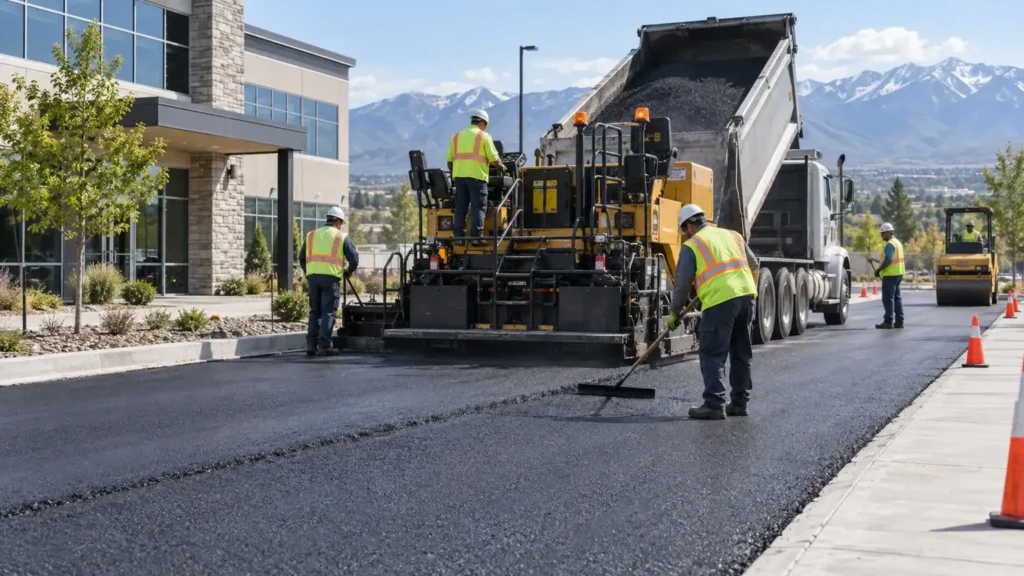
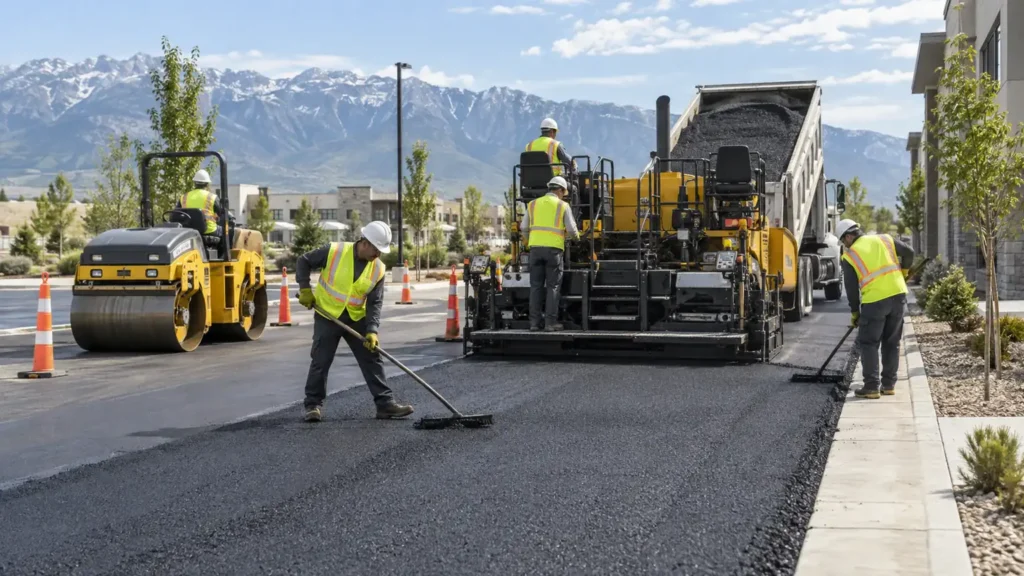
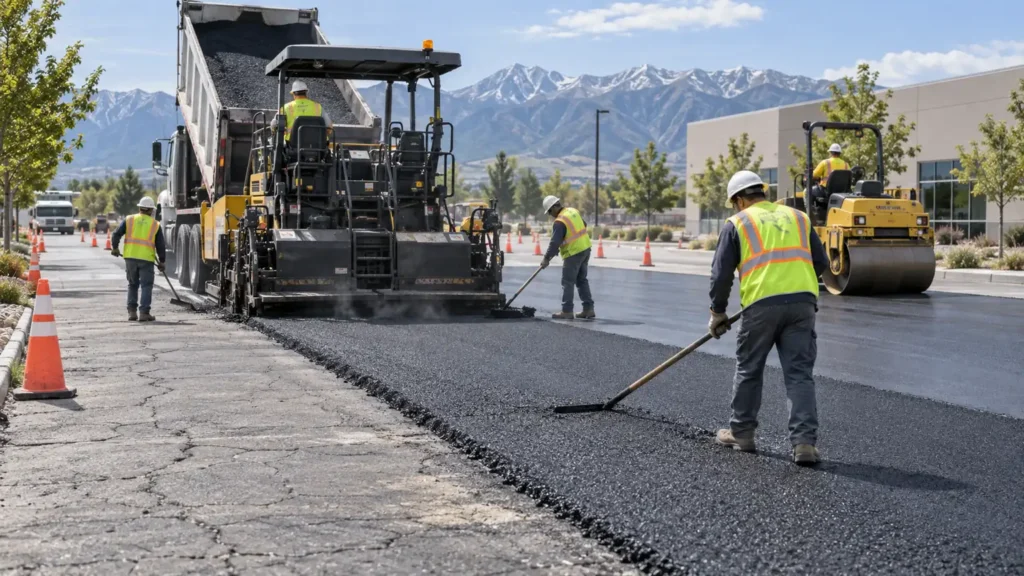
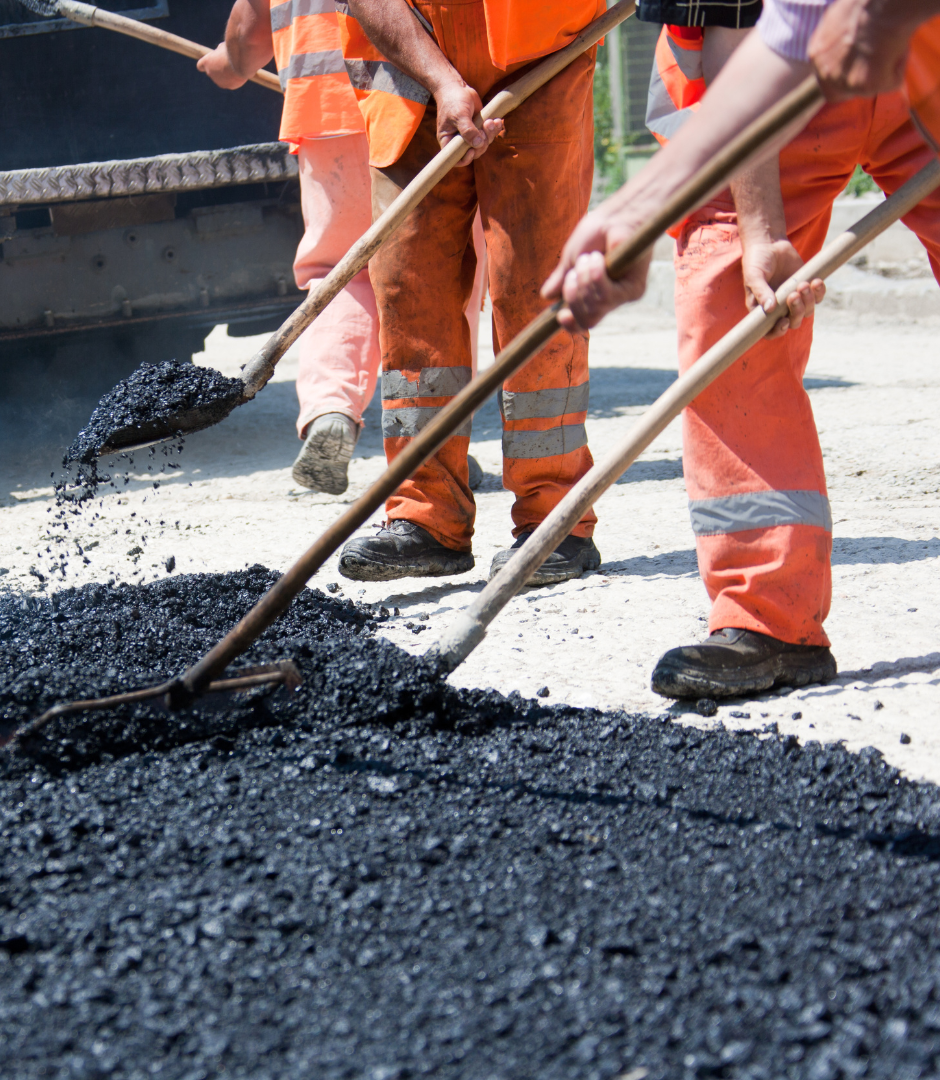
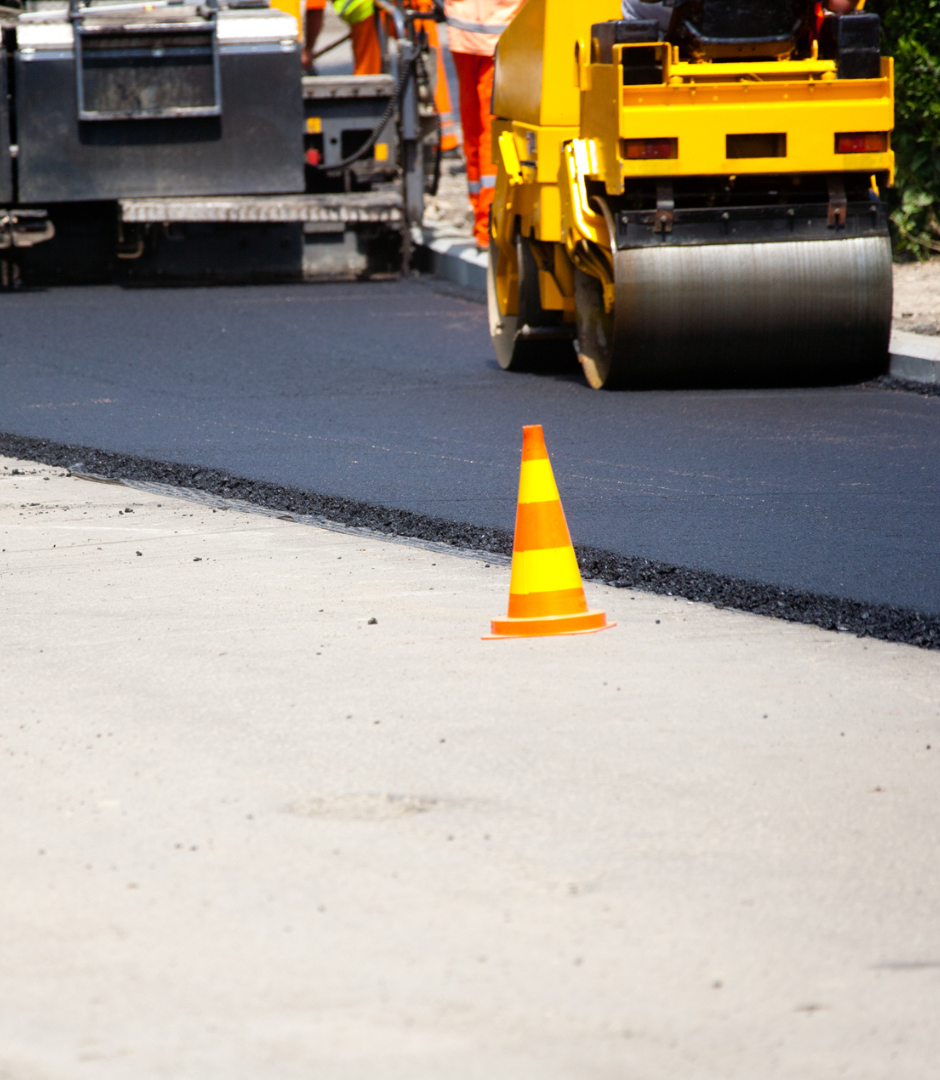
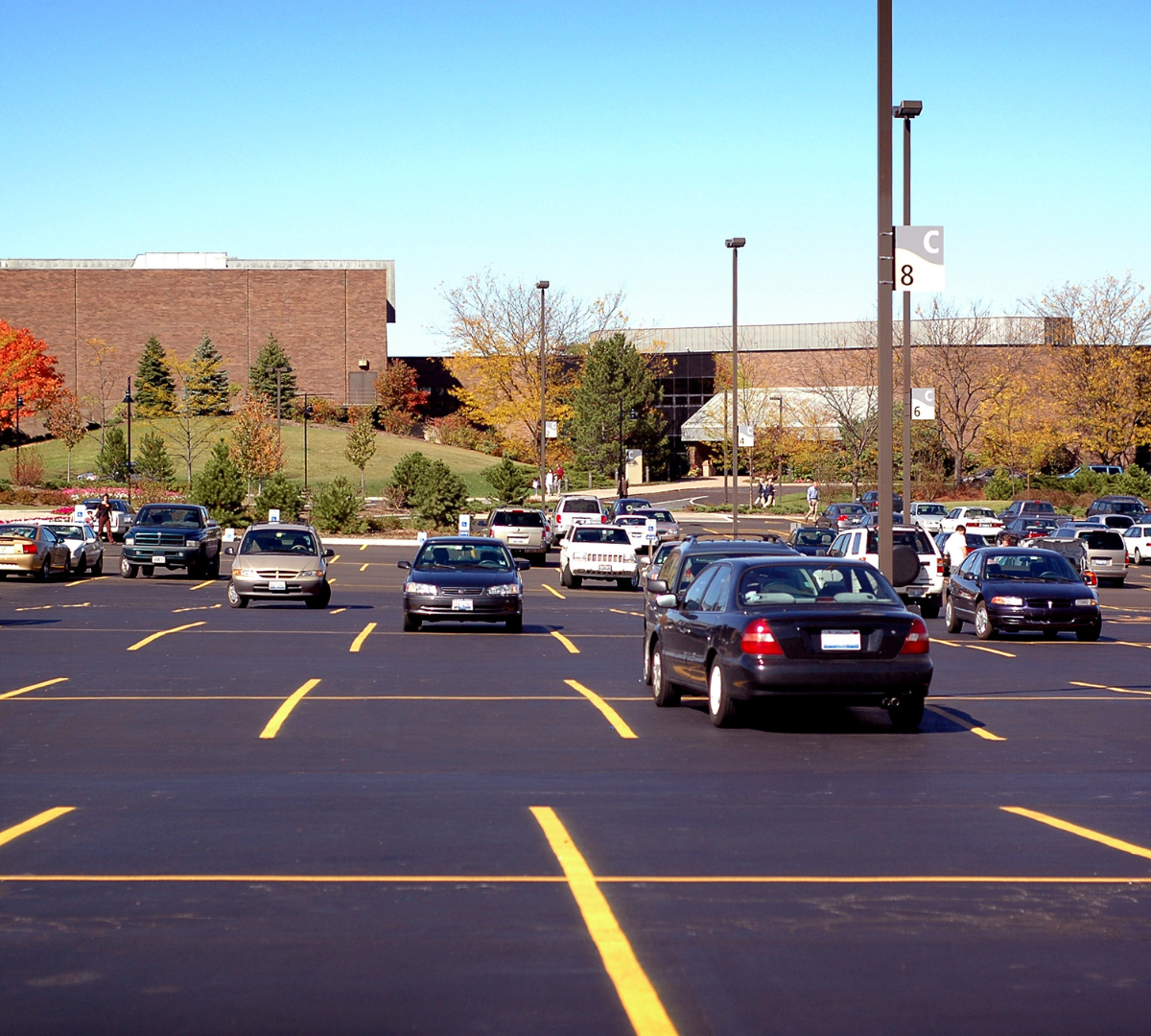
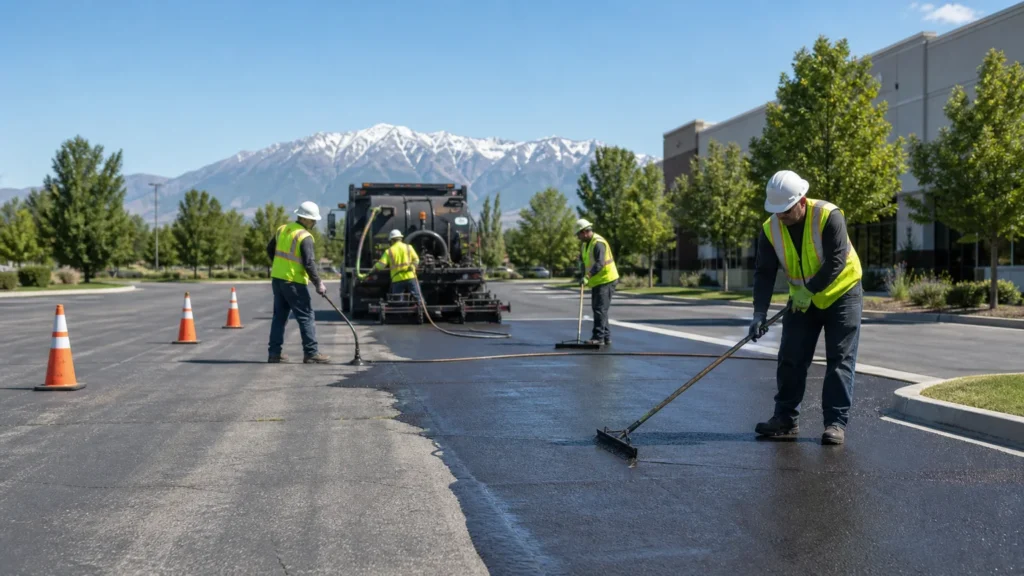
Original AI-assisted illustration of representative pavement maintenance work in Sandy, Utah; not a photograph of an 801 Asphalt project.

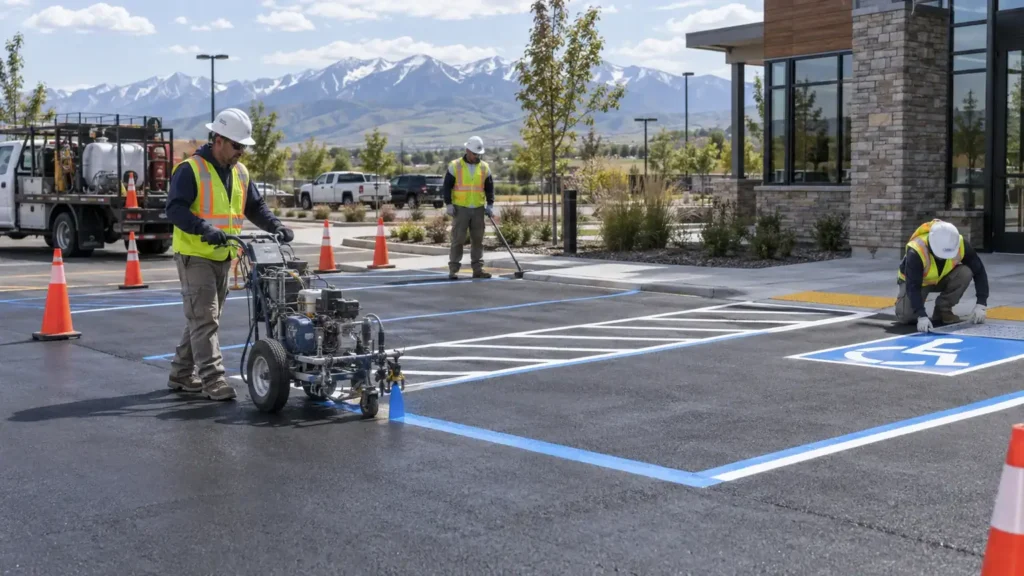
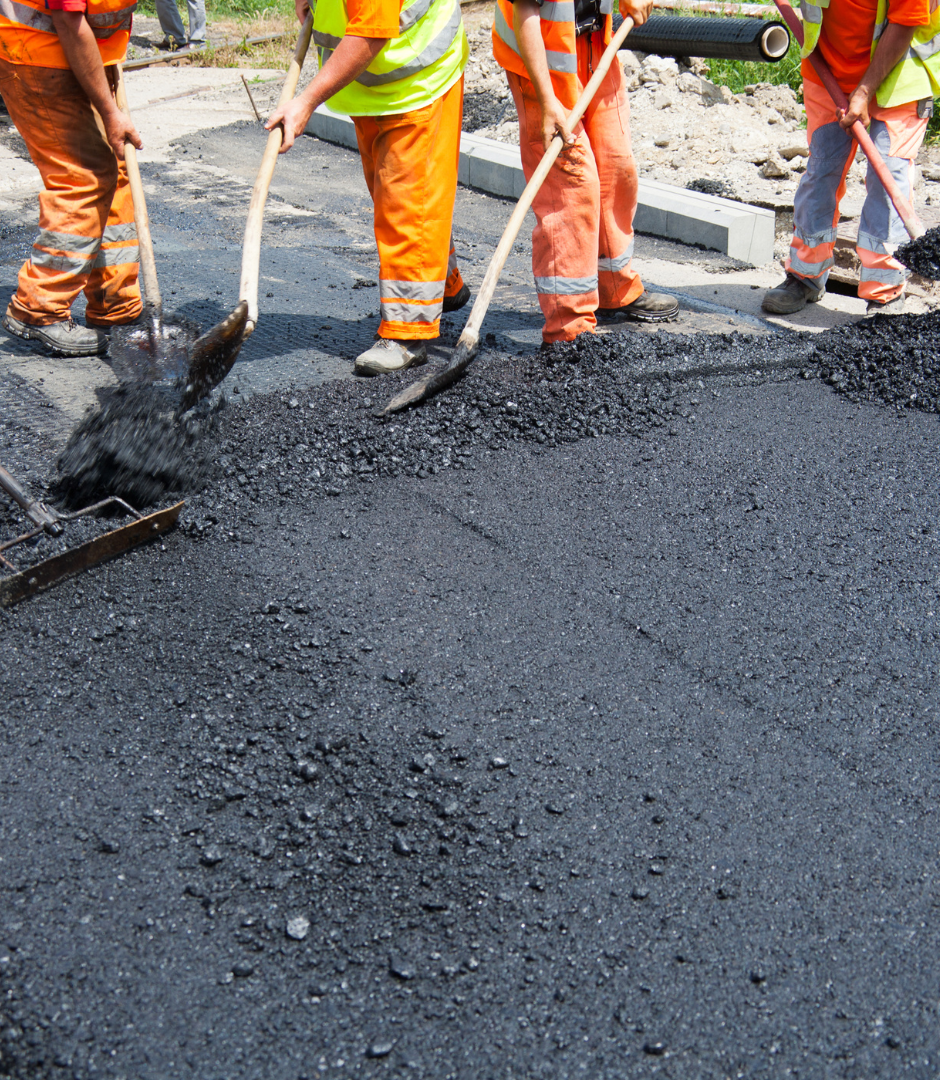
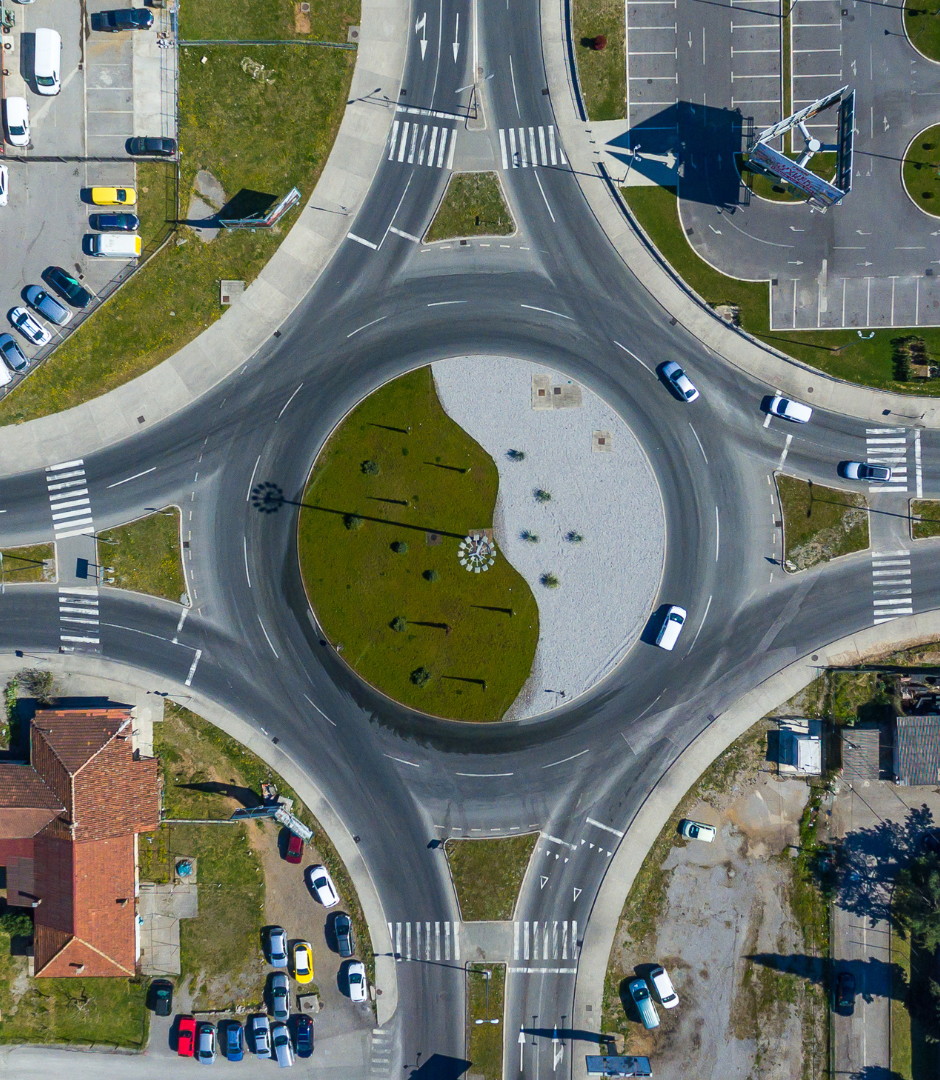
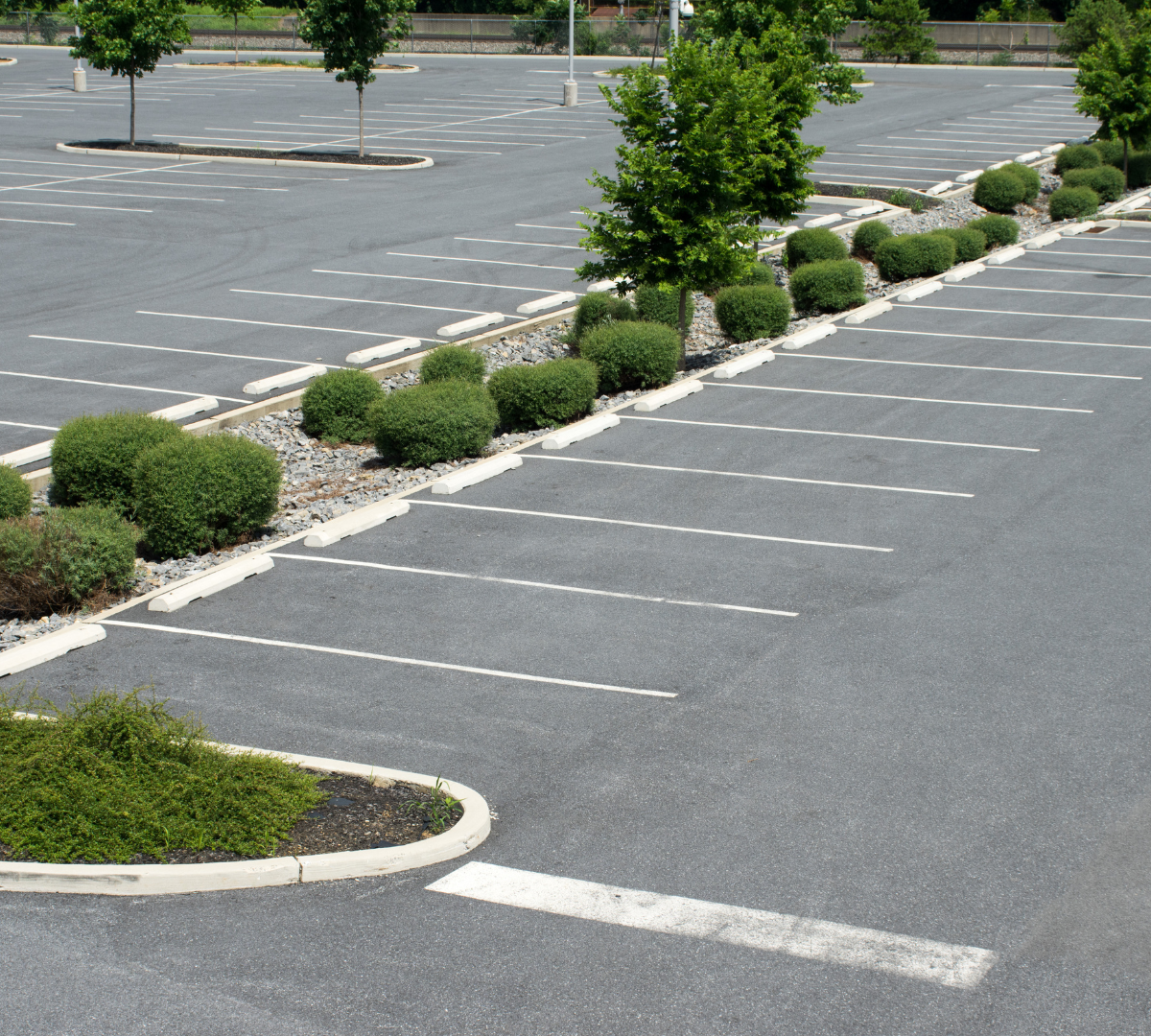
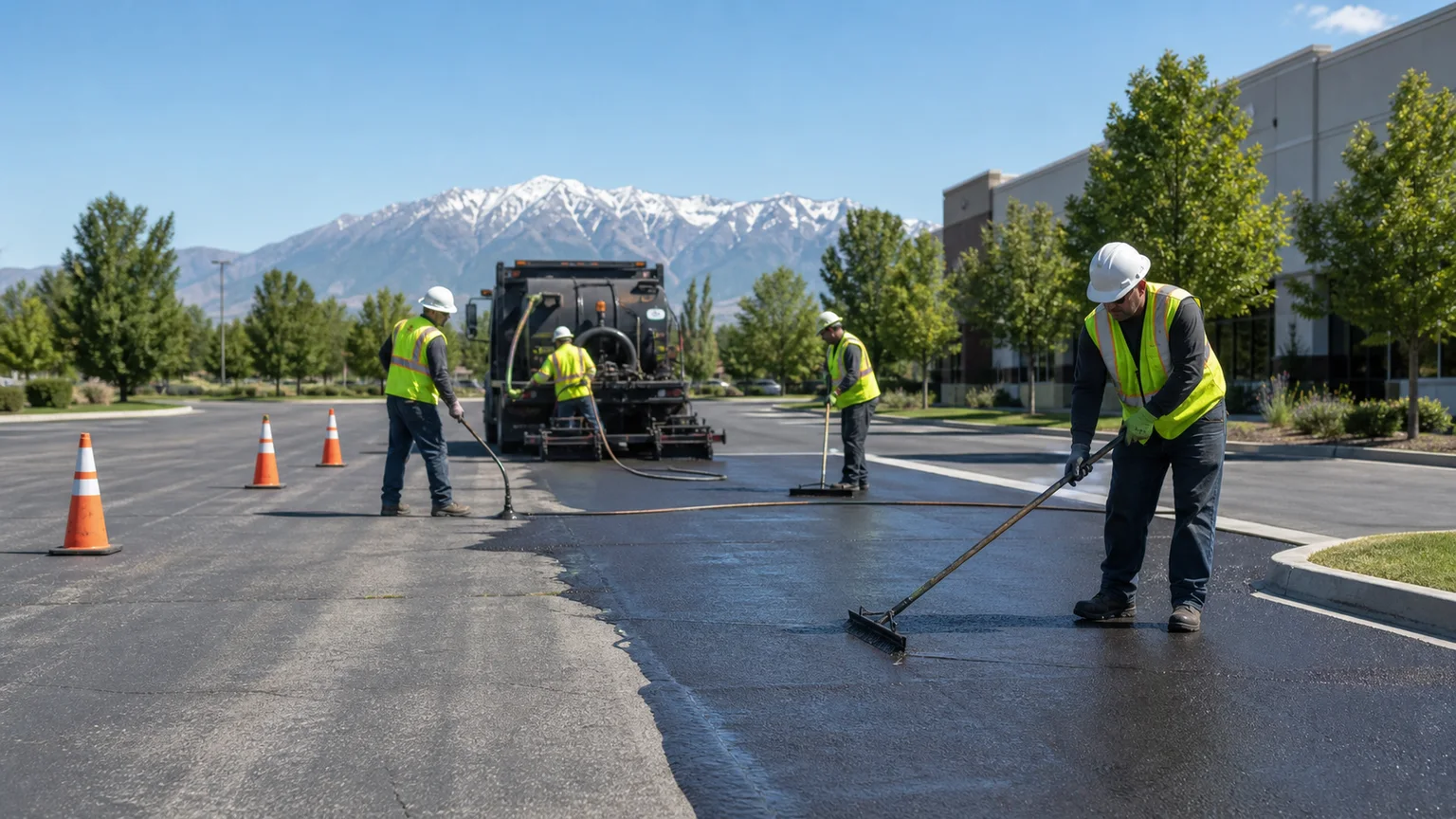
Original AI-assisted illustration of a representative pavement maintenance quality-control step in Sandy, Utah; not a photograph of an 801 Asphalt project.
2026 pavement maintenance budgeting in Sandy
The following current Utah contractor-published examples were checked August 26, 2026. They are starting points for budgeting—not quotes, a promise that every project falls inside the range, or evidence that one contractor is the cheapest.
| Scope | Published planning range | Unit | Major cost drivers | Source |
|---|---|---|---|---|
| Sealcoating component | $0.20–$0.50 | square foot | Size, access, preparation, traffic control, material and existing condition | 801 Asphalt pavement maintenance budget guide |
| Crack sealing component | $1–$3 | linear foot | Size, access, preparation, traffic control, material and existing condition | 801 Asphalt pavement maintenance budget guide |
| Standard painted stall example | $15–$25 | stall | Size, access, preparation, traffic control, material and existing condition | 801 Asphalt pavement maintenance budget guide |
| General localized patching | $2–$6 | square foot | Size, access, preparation, traffic control, material and existing condition | 801 Asphalt pavement maintenance budget guide |
Small projects can carry a higher unit cost because crew, equipment, trucking, traffic control, and setup are spread across fewer units. Large or repeatable phases may gain efficiency, while tight access, night work, deep repair, drainage correction, specialty materials, public interfaces, testing, and several mobilizations can raise the total.
Ask for measured quantities and alternates. A useful proposal can show a base scope, priority repairs, optional phases, unit prices for uncertain conditions, and work that should be deferred. That structure makes an 801 Asphalt quote easier to compare with another Utah proposal without claiming a guaranteed lowest price.
Three Sandy questions
How often should pavement be inspected?
At least annually is practical for many managed properties, with additional checks after winter, major runoff, utility work, or traffic changes. High-risk heavy routes or known drainage areas may justify more frequent review.
Should every zone receive the same treatment?
No. Age, loading, drainage, condition, access, and business importance differ. Zone-based planning can seal useful pavement, repair isolated failures, monitor stable areas, and reserve capital for reconstruction.
How is a maintenance budget kept competitive?
Use mapped quantities, treatment standards, alternate priorities, unit prices, and coordinated mobilizations. Ask bidders to price the same scope and distinguish preventive work from structural rehabilitation.
Scope-matched quote checklist
Use this checklist when comparing pavement maintenance proposals for Asphalt in Utah:
- Are the work limits and quantities mapped rather than described only as “all needed areas”?
- Does the proposal identify suitable and unsuitable conditions for the treatment?
- Are preparation, materials, application or placement rates, thicknesses, and quality checks stated?
- Are drainage, utilities, irrigation, structures, edges, and existing failures addressed?
- Are pedestrian, accessible-route, delivery, resident, customer, and emergency needs planned?
- Are weather limits, cure or cooling requirements, barriers, and reopening authority clear?
- Are mobilization, traffic control, testing, disposal, taxes, and specialty work included or excluded?
- Are unit prices and change-order triggers provided for uncertain conditions?
- Will the contractor document materials, quantities, weather, photographs, and completed areas?
- Do competing bids use the same map, assumptions, and acceptance criteria?
Turn the site walk into a comparable plan
Walk the property with a numbered map and photograph drainage, structures, utilities, traffic paths, edges, and each proposed work area. Ask every bidder to identify suitable and unsuitable treatment areas and to state measurable preparation, materials, quality controls, cure or reopening rules, and exclusions. Written equivalence is what makes a price comparison fair.
Learn about 801 Asphalt's pavement maintenance service, browse the Sandy asphalt article hub, and read the Sandy asphalt paving guide and Sandy asphalt repair guide.
Request a free project assessment or call (801) 277-4258. Ask for a scope-matched written quote that separates quantities, preparation, materials, traffic control, quality checks, and exclusions.
Editorial disclosure
Author: 801 Asphalt Editorial Team
Technical review: Automated source, pricing, link, image, claims, and duplication validation completed 2026-08-26; no unverified project-history, licensing, warranty, ranking, lowest-price, or city-experience claim was included.
Published and updated: 2026-08-26
AI assistance: AI assisted with drafting and the two original illustrations. The images are representative scenes, not photographs of 801 Asphalt projects.
Sources and review notes
- https://www.sandy.utah.gov/engineering
- https://www.sandy.utah.gov/standard-specifications-and-details-for-municipal-construction
- https://sandy.utah.gov/development-construction
- 801 Asphalt pavement maintenance budget guide
- 801 Asphalt paving cost guide
- 801 Asphalt parking lot striping cost guide
Sources and prices checked August 26, 2026. Contractor-published figures are market examples, not government schedules, independent averages, an 801 Asphalt price list, or guaranteed quotes. Applicable public or permitted work should be checked against current Sandy requirements and approved plans.